Advertisements
Advertisements
Question
The figure shows a radioactive source S placed in a thick-walled lead container. The radiations given off pass through a magnetic field acting in direction perpendicular to the plane of paper inwards as shown by X. Copy the diagram and show the path of radiations. Explain why the source is kept in a thick-walled lead container.
Advertisements
Solution
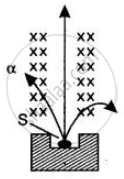
The given figure shows the path of radiation in the magnetic field. The source is kept in a thick-walled lead container so that it.
Radiations may not come out in the undesired direction otherwise they will harm the person working on.
RELATED QUESTIONS
In following Figure shows a mixed source R of alpha and beta particles in a thick lead walled container. The particles pass through a magnetic field in a direction perpendicular to the plane of paper inwards as shown by ×.
- Show in the diagram how the particles get affected.
- Name the law used in part (a).
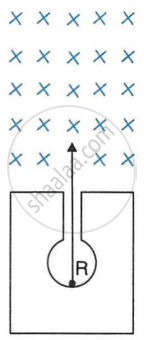
[Hint: Alpha particles will deflect to the left while beta particles to the right]
In following Figure shows a radioactive source S in a thick lead walled container having a narrow opening. The radiations pass through an electric field between the plates A and B.
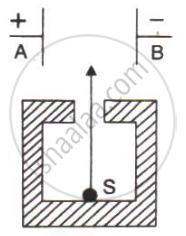
- Complete the diagram to show the paths of α, β and γ radiations.
- Why is the source S kept in a thick lead walled container with a narrow opening?
- Name the radiation which is unaffected by the electrostatic field.
- Which radiation is defleced the most. Given reason.
- Which among the three radiations causes the least biological damage?
Explain why alpha and beta particles are deflected in an electric or a magnetic field, but gamma rays are not deflected in such a field.
Is it possible to deflect γ - radiations in a way similar to α and β -particles, using the electric or magnetic field? Give reasons.
Arrange the α, β, and γ raditions in ascending order of their ionising powers.
What is the composition of α, β and γ radiations?
A radioactive substance emits radiations ______.
Compare the penetrating powers of α, β and γ-radiations.
Compare the ionising powers of α, β and γ radiations.
Which of the following radiations suffer maximum deflection in a magnetic field?
