Advertisements
Advertisements
Question
In following Figure shows a radioactive source S in a thick lead walled container having a narrow opening. The radiations pass through an electric field between the plates A and B.
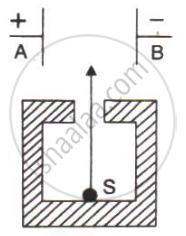
- Complete the diagram to show the paths of α, β and γ radiations.
- Why is the source S kept in a thick lead walled container with a narrow opening?
- Name the radiation which is unaffected by the electrostatic field.
- Which radiation is defleced the most. Given reason.
- Which among the three radiations causes the least biological damage?
Advertisements
Solution

- The radioactive substances are kept in thick lead containers with a very narrow opening, so as to stop radiations coming out from other directions because they may cause biological damage.
- Gamma radiations.
- Beta radiation (β) is the lighter of the two types of radiation, C and A, which are alpha radiation (α).
- Alpha particle.
APPEARS IN
RELATED QUESTIONS
A radioactive source emits three types of radiations.
Name the three radiations.
In following Figure shows a mixed source R of alpha and beta particles in a thick lead walled container. The particles pass through a magnetic field in a direction perpendicular to the plane of paper inwards as shown by ×.
- Show in the diagram how the particles get affected.
- Name the law used in part (a).
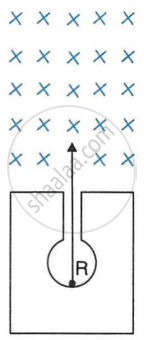
[Hint: Alpha particles will deflect to the left while beta particles to the right]
Is it possible to deflect γ - radiations in a way similar to α and β -particles, using the electric or magnetic field? Give reasons.
State following four properties each of α, β and γ radiations:
- Nature,
- Charge,
- Mass and
- Effect of electric field.
Arrange the α, β, and γ raditions in ascending order of their ionising powers.
What is the composition of α, β and γ radiations?
Arrange the α, β, and γ radiation in ascending order of their biological damage. Give reason.
Compare the ionising powers of α, β and γ radiations.
Which nuclear radiation will travel undeviated in an electric field?
Arrange the α, β and γ radiations in ascending order of their penetrating power.
