Advertisements
Advertisements
Question
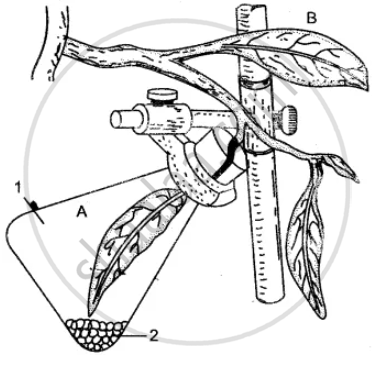
The figure below represents an experiment performed to demonstrate a particular aspect of photosynthesis. The apparatus was kept in sunlight for almost the whole day. The numeral ‘1’ represents a certain condition inside the flask and the numeral ‘2’ represents a chemical responsible for this condition.
(i) What is the object of the experiment?
(ii) What is the special condition inside the flask?
(iii) What is the chemical substance numbered ‘2’?
(iv) In what way will the three leaves (A, B, and C) differ at the end of the experiment, when tested with iodine solution?
Advertisements
Solution
(i) The object of this experiment is to show that CO2 is necessary for photosynthesis.
(ii) The special condition inside the flask is that there is no CO2 in the air as it has been absorbed by the KOH.
(iii) KOH or NaOH pellets.
(iv) Leaf A will be yellowish-white. Leaf B and Leaf C will turn blue-black.
APPEARS IN
RELATED QUESTIONS
Name the following:
The part of chloroplast where the dark reaction of photosynthesis takes place.
Identify the false statement and rewrite it correctly by changing the first or last word only.
Photosynthesis occurs only in cells containing chloroplasts.
Explain the term Photophosphorylation.
Complete the following sentence with appropriate word:
Calvin cycle was proposed by __________.
Mention, if the following statement is True or False. If false rewrite the wrong statement in its correct form:
Photosynthesis occurs only in plants.
Mention, if the following statement is True or False. If false rewrite the wrong statement in its correct form:
The unit of light absorbed by the chlorophyll during photosynthesis is the proton.
Mention, if the following statement is True or False. If false rewrite the wrong statement in its correct form:
All the starch produced in a leaf remains stored in it for 2-3 weeks before it is used by other parts of a plant.
The basic functional unit of solar energy which is absorbed by the pigment chlorophyll is ______.
Given below are groups of terms. The first pair indicates the relationship between the two terms. Complete the second pair accordingly.
Light reaction : Gran um : : Dark reaction : ______
Define the following term:
Thylakoids
