Advertisements
Advertisements
Question
The diagram represents fractional distillation for the separation of mixtures. Answer the following :
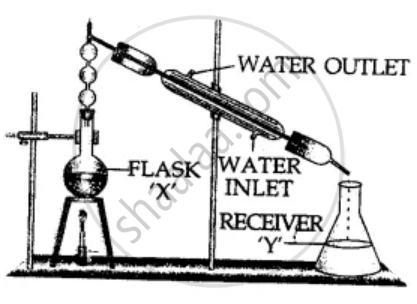
- Can two immiscible liquids be separated by this process?
- Separation of liquids by this process is based on which physical property?
- If methyl alcohol & water are to be separated, which liquid would remain in flask ‘X’ after condensation.
- Give a reason for the above answer.
- State the purpose of the fractionating column in the apparatus.
Advertisements
Solution
-
No, they can be separated by separating funnel.
- The physical property on which separation is based “Difference in their boiling points.”
-
Water having boiling point 100°C will remain in flask ‘X’.
- Alcohol having lower B.P. 78°C will evaporate first and condense in the conical flask — receiver ‘Y’.
- The upper part of the ‘Fractionating column is cooler, so as the hot vapours rise up in the column, they get cooled (condense) and trickle back into the distillation flask ‘X’.
APPEARS IN
RELATED QUESTIONS
Define: Elements
Name the technique that you use if only the solid component of a solution is required.
Name: a Liquid Non-metal
Give three differences between metals and non-metals.
What is meant by 2H and H2
Fill in the blank
A metal which is a poor conductor of electricity is _______.
Write an answer to the following question in your own words.
Which elements (metals and non-metals), compounds and mixtures do we use in our day-to-day life?
With reference to elements – define the term ‘molecule’. Give two examples each of a monoatomic, diatomic & polyatomic molecule.
Explain the term ‘mixture’.
______ is a mixture of gases.
