Advertisements
Advertisements
प्रश्न
The diagram represents fractional distillation for the separation of mixtures. Answer the following :
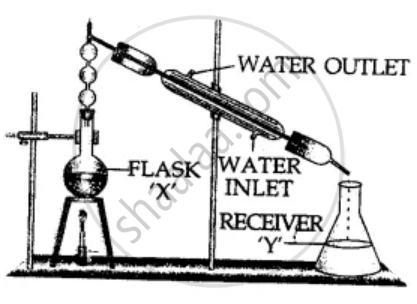
- Can two immiscible liquids be separated by this process?
- Separation of liquids by this process is based on which physical property?
- If methyl alcohol & water are to be separated, which liquid would remain in flask ‘X’ after condensation.
- Give a reason for the above answer.
- State the purpose of the fractionating column in the apparatus.
Advertisements
उत्तर
-
No, they can be separated by separating funnel.
- The physical property on which separation is based “Difference in their boiling points.”
-
Water having boiling point 100°C will remain in flask ‘X’.
- Alcohol having lower B.P. 78°C will evaporate first and condense in the conical flask — receiver ‘Y’.
- The upper part of the ‘Fractionating column is cooler, so as the hot vapours rise up in the column, they get cooled (condense) and trickle back into the distillation flask ‘X’.
APPEARS IN
संबंधित प्रश्न
Classify the following substances into elements and compounds
Mercury, sulphur, sugar, water, sand, gold, carbon, oxygen, alcohol, iron, marble, baking soda.
Give two examples of Noble gases.
Name: Three different forms of carbon
Indicate whether the following statement is true or false:
Elements are made up of compounds
Classify substances into pure and impure substances in the form of a chart or tabulation.
Select the correct answer from the choice given below.
The element which is malleable
Select the correct answer to the statement given below:
The chemical name for dinitrogen oxide [N20].
Give a reason for the following statement:
Components in a mixture are present in varying proportions and not in a fixed proportion.
Higher Order Thinking Skills.
List out the metals, non-metals and metalloids which you use in your house, schools. Compare their properties.
______ is the life-giving element is the air.
