Advertisements
Advertisements
Question
The diagram represents an isotope of hydrogen [H]. Answer the following:
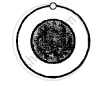
Atomic no. = 1
Mass no. = 1
Which sub-atomic particles in the 3 isotopes of ‘H’ are the same.
Advertisements
Solution
Protons and electrons in each isotope are the same.
APPEARS IN
RELATED QUESTIONS
State the mass number, the atomic number, number of neutrons and electronic configuration of the following atoms.
`""^12""_6C, ""^16""_8O, ""^19""_9F, ""^20""_10Ne, ""_13""Al""^27, ""_17""Cl""^35`
Also, draw atomic diagrams for them.
The atomic number and mass number of sodium are 11 and 23 respectively. What information is conveyed by this statement?
Give reason
Actual atomic mass is greater than mass number.
Match the atomic numbers 4,8,10,15 and 19 with each of the following:
An element which does not form ion
The diagram represents an isotope of hydrogen [H]. Answer the following:
Atomic no. = 1
Mass no. = 1
If an isotope of ‘H’ has mass no. = 2, how many electrons does it have.
The ratio of the radii of hydrogen atom and its nucleus is ~ 105. Assuming the atom and the nucleus to be spherical,
- what will be the ratio of their sizes?
- If atom is represented by planet earth ‘Re ’ = 6.4 ×10⁶ m, estimate the size of the nucleus.
When an atom gives electrons from its outermost shell, it becomes ______ charged.
If M is the atomic mass and A is the mass number, then packing fraction is given by ______.
Element ‘P' has electronic configuration 2,8,8,1. The number of chlorine atoms present in the chloride of ‘P’ is ______.
An element has 2 electrons in its N shell.
- What is its atomic number?
- State its position in the periodic table.
- Is it a metal or a non-metal?
- State the name assigned to this group.
- What is the valency of this element?
