Advertisements
Advertisements
Question
The diagram represents an isotope of hydrogen [H]. Answer the following:
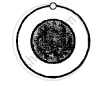
Atomic no. = 1
Mass no. = 1
If an isotope of ‘H’ has mass no. = 3, how many neutrons does it have.
Advertisements
Solution
Two neutrons. .........[∵ A = P + n]
APPEARS IN
RELATED QUESTIONS
The composition of the nuclei of two atomic species X and Y are given as under
| X | Y | |
| Protons | 6 | 6 |
| Neutrons | 6 | 8 |
Give the mass numbers of X and Y. What is the relation between the two species?
What are the atomic numbers of elements whose outermost electrons is represented by 3s1.
What is variable valency? Name two elements having variable valency and state their valencies.
Fill in the blank of the following statement :
The total number of protons and neutrons in the nucleus of an atom is called its _________.
The number of electrons in the atom of an element X is 15 and the number of neutrons is 16. Which of the following is the correct representation of an atom of this element ?
Draw the structure of the following atoms showing the nucleus containing – protons, neutrons and the orbits with the respective electron:
Silicon [At. no. = 14, Mass no. = 28]
Elements A, B and C have atomic numbers 9, 20 and 10 respectively.
- State which one is
(1) a non-metal,
(2) a metal,
(3) chemically inert.[A,B,C] - Write down the formula of the compound formed by two of the above elements.[BA2]
Mass No =______ + No. of Neutrons.
State the term for the following:
The amount of substance which contains the same number of units as the number of atoms in carbon-12.
A group of elements in the periodic table is given below (Boron is the first member of the group and Thallium is the last).
Boron, Aluminium, Gallium, Indium, Thallium
Answer the following question in relation to the above group of elements:
The atomic number of boron is 5. Write the chemical formula of the compound formed when boron reacts with chlorine.
