Advertisements
Advertisements
Question
The diagram given below represents the location and structure of an endocrine gland. Study the same and answer the questions that follow
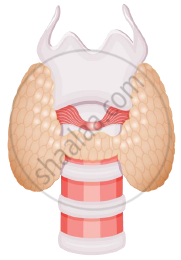
(i) Name the endocrine gland shown in the diagram.
(ii) Name the secretion of the gland which regulates basal metabolism.
(iii) Name the mineral element required for the synthesis of the above mentioned hormone.
(iv) Name the disease caused due to undersecretion of the above mentioned hormone in children.
(v) Name the disease caused due to hypersecretion of the above mentioned hormone.
Advertisements
Solution
(i) Thyroid gland
(ii) Thyroxine regulates the basal metabolism.
(iii) Iodine is required for the synthesis of thyroxine.
(iv) Cretinism
(v) Exophthalmic goitre
APPEARS IN
RELATED QUESTIONS
Give the exact location of the Adrenal gland
Name the following:
The hormone produced by adrenal medulla.
Name the following:
The hormone which stimulates the entire sympathetic nervous system.
If one adrenal gland is removed, the other one gets enlarged to some extent. How do you explain this change?
Some adult women may develop facial hairs. What may be the cause for it?
Give the Technical Term: Name the glands which secrete the following hormone: Adrenaline
Describe in brief, an account of disorders of the adrenal gland.
Sanjay is sitting in the exam hall. Before the start of the exam, he sweats a lot, with an increased rate of heartbeat. Why does this condition occur?
Which gland is represented by 'X' in the given diagram?
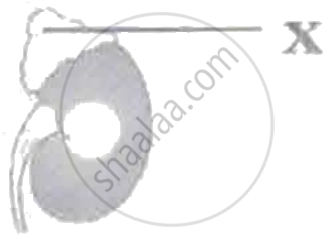
Choose the correct option among the following options
| Column I | Column II |
| A. Epinephrine | i. Stimulates muscle growth |
| B. Testosterone | ii. Decrease in blood pressure |
| C. Glucagon | iii. Breakdown of liver glycogen content |
| D. Atrial natriuretic factor | iv. Increases heart beat |
