Advertisements
Advertisements
Question
The diagram given below represents an endocrine gland in the human body. Study the diagram and answer the following questions:
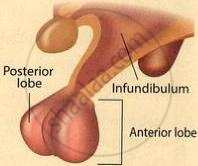
- Identify the endocrine gland. Where is it located?
- Why is the above gland referred to as the 'Master gland'?
- Name the hormone which in deficiency causes diabetes insipidus.
- Explain the term 'hormone'. What is the role of tropic hormones in the human body?
- Which lobe of the above gland secretes:
- Oxytocin
- ACTH
- Growth hormone
Very Long Answer
Advertisements
Solution
-
- Identity: The endocrine gland shown in the diagram is the pituitary gland.
- Location: It is located at the base of the brain, attached to the hypothalamus by a stalk called the infundibulum.
- The pituitary is called the master gland because its hormones regulate the activity of several other endocrine glands.
- A deficiency of Antidiuretic Hormone (ADH), which is also known as Vasopressin, causes diabetes insipidus.
- A hormone is a chemical messenger produced by an endocrine gland and carried in the blood to act on specific target cells or organs.
Tropic hormones act on other endocrine glands, stimulating them to grow or release their hormones. For example, TSH acts on the thyroid gland, while ACTH acts on the adrenal cortex. -
- Oxytocin: It is secreted by the posterior lobe.
- ACTH: It is secreted by the anterior lobe.
- Growth hormone: It is secreted by the anterior lobe.
shaalaa.com
Is there an error in this question or solution?
