Advertisements
Advertisements
Question
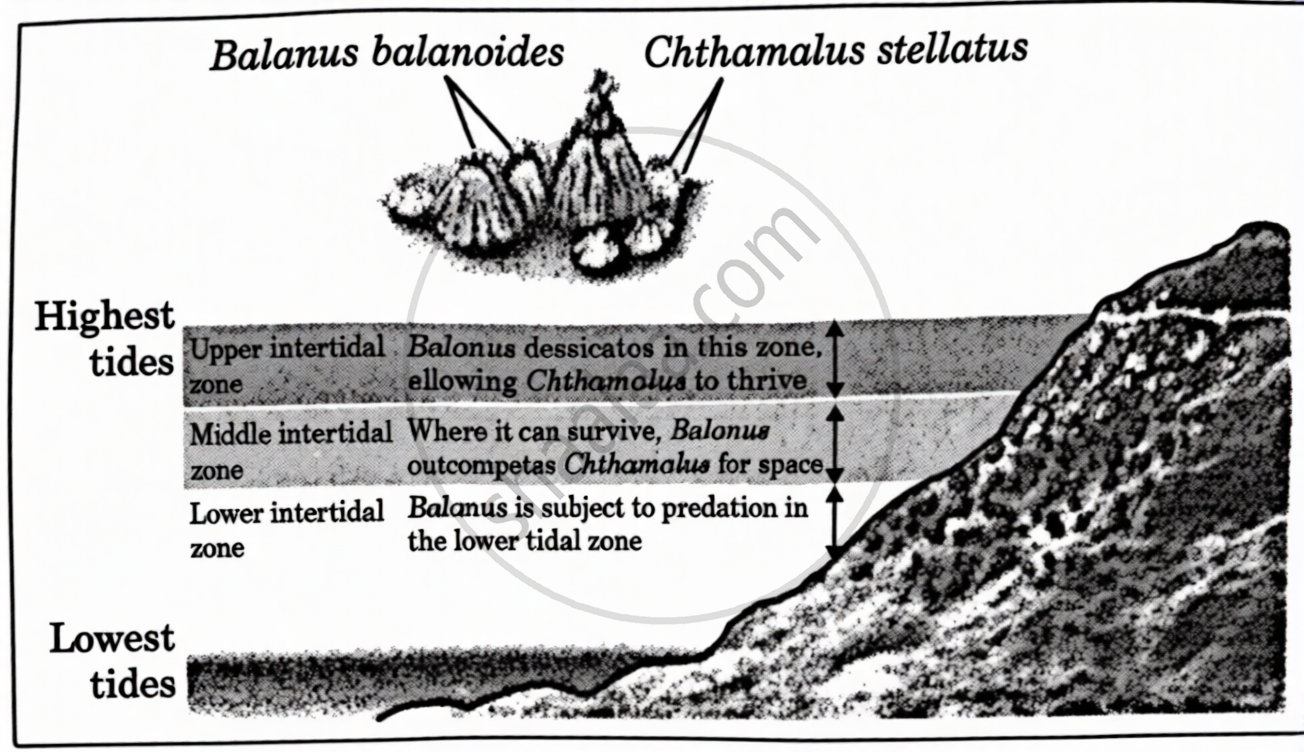
The diagram below shows the distribution of two barnacle species, Chthamalus and Balanus on a rocky sea shore.
When Balanus is experimentally removed, Chthamalus expands its range in lower intertidal zone.
(a) Identify and define the ecological phenomenon demonstrated by this observation. [1]
OR
(a) State the principle that explains the elimination of one species. [1]
(b) Two different species can compete for the same resource. Give another example of it. [1]
(c) How do species avoid competition in nature? Explain with an example. [2]
Advertisements
Solution
(a) Competitive exclusion (observed as competitive release).
Definition: when one species (Balanus) outcompetes and excludes another (Chthamalus) from part of its habitat; removing the dominant species allows the inferior competitor to expand into that area.
OR
(a) Competitive Exclusion (Gause) principle: Two species competing for the same limiting resources cannot stably coexist; the better competitor will exclude the other.
(b) Two herbivorous fish species feed on the same phytoplankton they compete for the same food resource.
(c) By niche partitioning/resource partitioning, species use different parts of a resource or use it at different times (e.g., two coexisting species may feed on the same food but at different depths/times or occupy different microhabitats). This separation of niches reduces direct competition and allows coexistence.
