Advertisements
Advertisements
Question
The centroid of a triangle ABC is at the point (1, 1, 1). If the coordinates of A and B are (3, –5, 7) and (–1, 7, –6) respectively, find the coordinates of the point C.
Advertisements
Solution
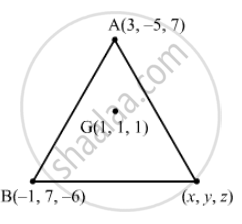
Let G be the centroid of\[∆\]ABC.
Given: G\[\equiv \left( 1, 1, 1 \right)\]
Let C\[\equiv \left( x, y, z \right)\]
\[\text{ Then }, 1 = \frac{3 - 1 + x}{3}\]
\[ \Rightarrow 3 = 3 - 1 + x \]
\[ \Rightarrow 3 = 2 + x \Rightarrow x = 1\]
\[\text{ and } 1 = \frac{- 5 + 7 + y}{3} \]
\[ \Rightarrow 3 = 2 + y \]
\[ \Rightarrow y = 1\]
\[\text{ and } 1 = \frac{7 - 6 + z}{3}\]
\[ \Rightarrow 3 = 1 + z\]
\[ \Rightarrow z = 2\]
\[\therefore C \equiv \left( 1, 1, 2 \right)\]
APPEARS IN
RELATED QUESTIONS
Find the distance between the following pairs of points:
(–1, 3, –4) and (1, –3, 4)
Find the distance between the following pairs of points:
(2, –1, 3) and (–2, 1, 3)
Show that the points (–2, 3, 5), (1, 2, 3) and (7, 0, –1) are collinear.
Verify the following:
(0, 7, 10), (–1, 6, 6) and (–4, 9, 6) are the vertices of a right angled triangle.
Verify the following:
(–1, 2, 1), (1, –2, 5), (4, –7, 8) and (2, –3, 4) are the vertices of a parallelogram.
Find the equation of the set of points which are equidistant from the points (1, 2, 3) and (3, 2, –1).
Find the equation of the set of points P, the sum of whose distances from A (4, 0, 0) and B (–4, 0, 0) is equal to 10.
Find the distance between the points P and Q having coordinates (–2, 3, 1) and (2, 1, 2).
Using distance formula prove that the following points are collinear:
A(4, –3, –1), B(5, –7, 6) and C(3, 1, –8)
Using distance formula prove that the following points are collinear:
P(0, 7, –7), Q(1, 4, –5) and R(–1, 10, –9)
Determine the points in xy-plan are equidistant from the points A(1, –1, 0), B(2, 1, 2) and C(3, 2, –1).
Show that the points (0, 7, 10), (–1, 6, 6) and (–4, 9, 6) are the vertices of an isosceles right-angled triangle.
Show that the points A(1, 3, 4), B(–1, 6, 10), C(–7, 4, 7) and D(–5, 1, 1) are the vertices of a rhombus.
Prove that the tetrahedron with vertices at the points O(0, 0, 0), A(0, 1, 1), B(1, 0, 1) and C(1, 1, 0) is a regular one.
Show that the points (3, 2, 2), (–1, 4, 2), (0, 5, 6), (2, 1, 2) lie on a sphere whose centre is (1, 3, 4). Find also its radius.
If the distance between the points P(a, 2, 1) and Q (1, −1, 1) is 5 units, find the value of a.
Write the coordinates of third vertex of a triangle having centroid at the origin and two vertices at (3, −5, 7) and (3, 0, 1).
Find the distance of the point whose position vector is `(2hati + hatj - hatk)` from the plane `vecr * (hati - 2hatj + 4hatk)` = 9
Find the distance of the point (– 2, 4, – 5) from the line `(x + 3)/3 = (y - 4)/5 = (z + 8)/6`
Find the distance of the point (–1, –5, – 10) from the point of intersection of the line `vecr = 2hati - hatj + 2hatk + lambda(3hati + 4hatj + 2hatk)` and the plane `vecr * (hati - hatj + hatk)` = 5.
The distance of a point P(a, b, c) from x-axis is ______.
Find the shortest distance between the lines given by `vecr = (8 + 3lambdahati - (9 + 16lambda)hatj + (10 + 7lambda)hatk` and `vecr = 15hati + 29hatj + 5hatk + mu(3hati + 8hatj - 5hatk)`
Find the equation of the plane through the intersection of the planes `vecr * (hati + 3hatj) - 6` = 0 and `vecr * (3hati + hatj + 4hatk)` = 0, whose perpendicular distance from origin is unity.
The distance of the plane `vecr * (2/4 hati + 3/7 hatj - 6/7hatk)` = 1 from the origin is ______.
If one of the diameters of the circle x2 + y2 – 2x – 6y + 6 = 0 is a chord of another circle 'C' whose center is at (2, 1), then its radius is ______.
The points A(5, –1, 1); B(7, –4, 7); C(1, –6, 10) and D(–1, –3, 4) are vertices of a ______.
