Advertisements
Advertisements
Question
The cells in our blood which destroy disease-causing germs are:
Options
Platelets
Skin cells
RBCs
WBCs
Advertisements
Solution
WBCs
White blood cells or WBCs destroy the disease-causing germs. They are like soldiers that protect the body from various infections.
APPEARS IN
RELATED QUESTIONS
The diagram below represents the human heart in one phase of its function. Study the diagram carefully and answer the questions that follow:
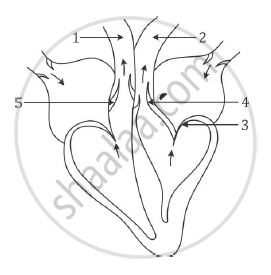
(i) Name the phase.
(ii) Which part of the heart is contracting in this phase? Give a reason to support your answer.
(iii) Name the parts labelled 1 to 4.
(iv) What type of blood flows through ‘2’?
(v) State the function of the part numbered ‘5’.
(vi) Name the membrane that covers the heart.
Give technical terms for The protective covering of the heart
Blood in the pulmonary artery or pulmonary vein (Which one contains less oxyhaemoglobin ?)
Mention the exact location of the Pulmonary semilunar valve
Which organ acts as a pump in the circulatory system?
Agranulocytes are :
Heart sounds are produced due to ______.
-
closure of tricuspid and bicuspid valves
-
rushing of blood through valves producing turbulence
-
closure of atrioventricular and semilunar valves
-
entry of blood into auricles
Name the following:
The smallest common blood vessels formed by the union of capillaries.
What is the function of tonsils?
Give reason for the following:
Atrial wall is less muscular than the ventricular wall.
Find out my partner.
| Group 'A' | Group 'B' |
| 1. Heart beats | a. 350 ml |
| 2. RBC | b. 7.4 |
| 3. WBC | c. 37∘C |
| 4. Blood donation | d. 72 |
| 5. Normal body Temperature | e. 50-60 lakh/mm3 |
| 6. pH of oxygenated blood | f. 5000-6000 per mm3 |
Explain the following:
Why is the closed circulatory system more efficient than the open system?
Why does the left ventricle possess a thicker wall than the right ventricle?
Put a tick mark (✓) against the correct alternative in the following statement.
Pulmonary vein carries
Fill in the blanks with suitable words given below:
The liquid part of coagulated blood is known as ______.
Define the Arteries.
State the Location: Bicuspid value
Respiration takes place because of its up and down movement.
Analogy
Arteries : Carry blood from the heart:: _________ :carry blood to the heart.
