Advertisements
Advertisements
प्रश्न
The cells in our blood which destroy disease-causing germs are:
पर्याय
Platelets
Skin cells
RBCs
WBCs
Advertisements
उत्तर
WBCs
White blood cells or WBCs destroy the disease-causing germs. They are like soldiers that protect the body from various infections.
APPEARS IN
संबंधित प्रश्न
The blood from the heart is transported to all parts of the body by the ______.
The diagram given below represents a section of the human heart. Answer the questions that follow :
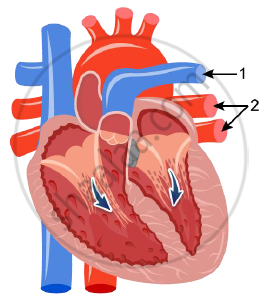
(i) Which parts of heart are in the diastolic phase? Give a reason to support your answer.
(ii) Label the parts numbered 1 and 2 in the diagram. What type of blood flows through them?
(iii) What causes the heart sounds ‘LUBB’ and ‘DUP’?
(iv) Name the blood vessels that supply oxygenated blood to the heart muscles.
(v) Draw neat labelled diagrams of a cross section of an artery and a vein.
State the functions of blood in our body.
What is Diapedesis?
Note the relationship between the first two words and suggest the suitable word/ word for the
fourth place:
Lubb: Atrioventricualr valves :: dup: …………………
Note the relationship between the first two words and suggest a suitable word/words for the fourth place:
Coronary artery : Heart :: Hepatic artery : ______
Why do people have a common belief that the heart is located on the left side of the chest?
Match the items in Column ‘A’ with those in column ‘B’ Rewrite the correct matching pairs.
| Column A | Column B | ||
| (a) | SA Node | (i) | Plasma |
| (b) | Defective haemoglobin in RBC | (ii) | Serum |
| (c) | Muscle fibres located in heart | (iii) | Pacemaker |
| (d) | The liquid squeezed out of blood during clotting | (iv) | Sickle cell anaemia |
| (e) | Never tires, keep on contracting and relaxing | (v) | Purkinje fibres |
| (f) | Cardiac cycle | (vi) | Cardiac muscle |
| (g) | Liquid part of the blood without corpuscles | (vii) | 0·85 sec |
What is diastole?
Give reason for the following:
The blood groups of both the donor and recipient must be known before transfusing blood.
Given diagram shows a simple diagram of the circulation of blood in a mamma showing the
main blood vessels, the heart, lungs and body tissues. The blood vessel, labelled 6, contains
deoxygenated blood and the valve leading to it has three semi-lunar pockets.

(a) Name the blood vessels and organs marked by numbers 1 to 8.
(b) What is meant by the term ‘double circulation’ of blood in mammals?
(c) what is diastole?
[There is an “error” in the diagram. According to the usual practice the pulmonary (lung)
circulation is shown upward and the systemic downward, but here it is reversed].
Fill in the blanks with suitable words given below:
The carbon dioxide loaded blood from right ventricle is pumped into the lungs through ______.
Describe the functions of the: Blood
Describe, in brief, the circulatory system in human beings.
Name the Following
Oxygen is transported by the blood in the form of
The stomach is like a ______.
Which of the following is/are required for the production of RBCs?
______ is a granulocyte.
Assertion (A): RBCs help in the transport of respiratory gases.
Reason (R): The cytoplasm of RBCs contains the respiratory pigment Haemoglobin.
Identify the normal haemoglobin count in human females.
