Advertisements
Advertisements
प्रश्न
The excretory organs in an earthworm are:
(a) nephridia
(b) nephrons
(c) raphides
(d) ureters
Advertisements
उत्तर
(a) nephridia
In earthworm, the main excretory organs are nephridia. It functions like a kidney.
APPEARS IN
संबंधित प्रश्न
Mention the exact location of the Prostate gland.
The form in which glucose in stored in liver.
Write the functions of the Urinary bladder
Name a waste gas released by the plants only during the night time.
Where is urine carried through ureters?
The organs A of a person have been damaged completely due to which too much of a poisonous waste material B has started accumulating in his blood, making it dirty. In order to save this person's life, the blood from an artery in the person's arm is made to flow into long tubes made of substance E which are kept in coiled form in a tank containing solution F. This solution contains three materials G, H and I in similar proportions to those in normal blood. As the person's blood passes through long tubes of substance E, most of the wastes present in it go into solution. The clean blood is then put back into a vein in the arm of the person for circulation.
(a) What are organs A?
(b) Name the waste substance B.
(c) What are (i) E, and (ii) F?
(d) Name G, H and I.
(e) What is the process described above known as?
Tick the most appropriate answer.
The process of removing waste from the body is called
Name the following:
The tuft of capillaries inside the Bowman's capsule.
Differentiate between the following pairs of term :
Renal cortex and renal medulla
Given below is a simplified diagram of the human kidney cut open longitudinally. Answer the questions that follow.
 |
- Define excretion.
- Why does the cortex of the kidney show a dotted appearance?
- Why does the medulla of the kidney show a striped appearance?
- Write two differences in the composition of the blood flowing through the blood vessels 'A' and 'B'.
Explain in your own words with suitable examples.
How is excretion in plants useful to human beings?
Given below is a diagram of a human kidney, cut open longitudinally. Answer the following:

(i) Give definition of excretion.
(ii) Name the unit of kidney.
(iii) Why does the cortex of kidney show dotted appearance?
(iv) List the functions of the kidney.
Name the Following
The structural and functional units of kidney
Write the functional activity of the following structure:
Glomerulus
Choose the correct option.
In human beings, uric acid is formed due to metabolism of ______.
Hypotonic filtrate is formed in _______.
Answer the following question.
Amphibian tadpole can afford to be ammonotelic. Justify.
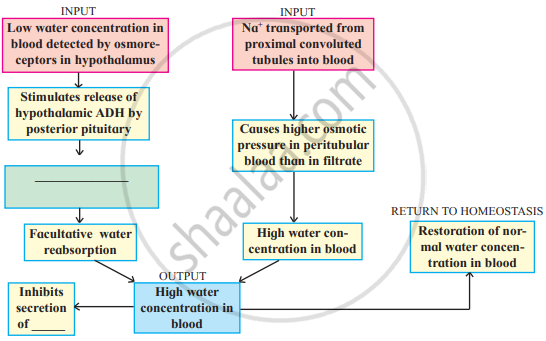
Complete the diagram/chart with correct labels/ information. Write the conceptual details regarding it.
Given below is a list of substances - select the ones that need to be eliminated from the body.
Glucose, excess water, amino acids, urea, carbon dioxide, excess common salt, glycogen, uric acid.
An organ that produces urea:
