Advertisements
Advertisements
प्रश्न
The excretory organs in an earthworm are:
(a) nephridia
(b) nephrons
(c) raphides
(d) ureters
Advertisements
उत्तर
(a) nephridia
In earthworm, the main excretory organs are nephridia. It functions like a kidney.
APPEARS IN
संबंधित प्रश्न
Mention the exact location of the Prostate gland.
the biological/technical terms for the hormone increasing reabsorption of water by kidney tubules
Name the two waste products of the human body which are produced in the body cells.
Fill in the following blank with suitable word:
Bowman's capsule and tubule taken together make a..........
A dialysis machine contains long tubes coiled in a tank containing dialysing solution
Name the main waste which passes into the dialysing solution.
Fill in the blank.
Malpighian body consists of Bowman’s capsule and .....................
Answer the following in detail.
Describe the process of urine formation.
Explain in your own words with suitable examples.
How does excretion occur in human beings?
Choose the odd one out in the following series:
Proximal convoluted duct, loop of Henle, vein.
Choose the odd one out in the following series:
Renal fat, renal capsule, nerve.
Name the following:
Functional unit of kidney.
The following diagram represents a mammalian kidney tubule (nephron) and its blood supply.
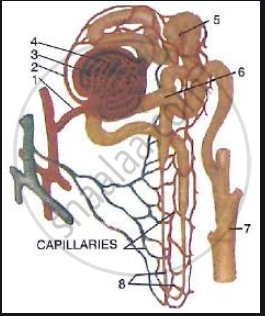
Parts indicated by the guidelines 1to 8 are as follows:
1. Afferent arteriole from renal artery
2. Efferent arteriole
3. Bowman's capsule
4. Glomerulus
5. Proximal convoluted tubule with blood capillaries
6. Distal convoluted tubule with blood capillaries
7. Collecting tubule
8. U-shaped loop of Henle
Study the diagram and answer the question that follow:
Which structure contains the highest concentration of urea?
Given below is a simple diagram of the human kidney cut open longitudinally. Answer the following questions: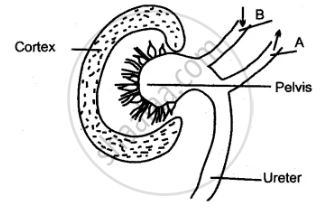
c
(v) Write two differences in the composition of the blood flowing through blood vessels A and B.
Name the Following
The branch of renal artery which enters into Bowman’s capsule.
Name the Following
The process by which kidneys regulate the water content of the body.
Name the Following
The substance found in excess in the urine of a diabetic patient.
State the Location: Medulla of Kidney
Choose the correct option.
Which one of the following organisms would spend maximum energy in the production of nitrogenous waste?
Choose the correct option.
In human beings, uric acid is formed due to metabolism of ______.
