Advertisements
Advertisements
Question
The below diagram is of a developing embryo is a mother’s womb:
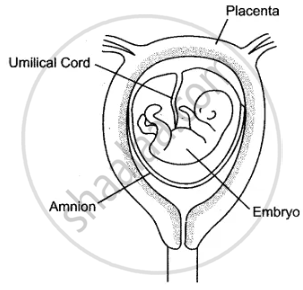
(i) Write the functions of the placenta, amnion, and umbilical cord.
(ii) How are the waste products of a fetus removed?
(iii) What is the gestation period?
Advertisements
Solution
(i) Functions:
1. It supplies oxygen, water, nutrients and hormones from the mother to embryo.
2. It transfers. carbon dioxide and other waste materials from the embryo to the mother’s blood.
3. It shields the embryo from infections as it is impermeable to most of the microorganisms present in the mother’s blood.
4. It produces certain hormones like oestrogen and progesterone which are essential for the reproductive process.
The amnion or amniotic sac is made up of protective membranes that are formed around the embryo. It encloses a fluid-filled space which acts as a water-bath and excellent shock absorption for the young embryo.
5. The embryo that develops in the placenta is maintained at a constant temperature, is well protected and nourished by the umbilical cord.
(ii) Waste products of the fetus are removed through the umbilical cord.
(iii) The interval of time between fertilization and birth is called the gestation period. It is about 280 days in human beings.
RELATED QUESTIONS
What are the male gonads in human beings?
One of the following is not a part of the human male reproductive system. This is
(a) testis
(b) oviduct
(c) seminal vesicle
(d) prostrate gland
The ratio of the number of chromosomes in a human zygote and a human sperm is ______
The diagram below represents two reproductive cells A and B. Study the same and then answer the questions that follow:
 |
- Identify the reproductive cells A and B.
- Name the specific part of the reproductive system where the above cells are produced.
- Where in the female reproductive system do these cells unite?
- Name the main hormones secreted by the (1) ovary (2) testes.
- Name an accessory gland found in the male reproductive system and state the function of its secretion.
Describe in brief the role of testis in human male reproductive system.
Describe the role of the following in human beings:
(i) Seminal vesicles
(ii) Prostate gland
Explain how the sex of the child is determined at the time of conception in human beings.
Define the following:
Monoceious
Gestation period in man
