Advertisements
Advertisements
Question
Study the diagram given below and then answer the questions that follow:
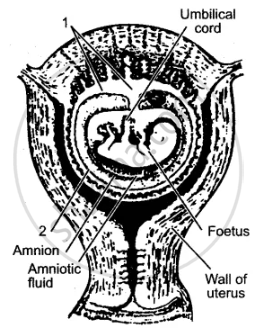
(i) Name the parts labeled 1 and 2. State the function of each part.
(ii) State any one function of the amniotic fluid.
(iii) What is the role of the umbilical cord in the development of the fetus?
(iv) Name the part in the diagram which is endocrine in nature.
Advertisements
Solution
(i)
1. Placenta - It helps irtIe nutrition, excretion and respiration of the embryo.
2. Chorion - It forms the placenta
(ii) The amniotic fluid present in the amniotic cavity acts as a shock absorber and prevents desiccation of embryo.
(iii) The umbilical cord makes the connection between placenta and foetus. It supplies the nutrients and O2 with maternal blood; to a foetus and removes CO2 and excretory wastes from foetus blood into maternal blood. Thus it acts as a transport channel between a foetus and mother blood.
(iv) Placenta - Secrets HCG (Human Chorionic Gonadotropin) hormone.
APPEARS IN
RELATED QUESTIONS
Name the following:
The membrane which protects the foetus and encloses a fluid
Given below is the name of certain stage/substance related to reproduction and found in human body. Answer the questions related to it.
Placenta
- What are the two sources that form placenta?
- Name any two main substances which pass from foetus to mother through placenta.
- Name any two hormones it produces.
Describe the functions of Amnion
Name the following:
The structure which connects the placenta and the foetus.
The diagram given below is that of a developing human foetus in the womb. Study the same and then answer the questions that follow:
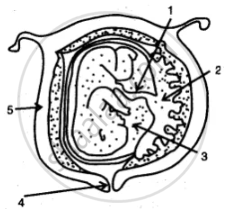
- Name the parts '1' to '5' indicated by guidelines.
- What term is given to the period of development of the foetus in the womb?
- How many days does the foetus take to be fully developed?
- Mention two functions of the parts labelled ‘2’ other than its endocrine function.
- Name the hormone (anyone) produced by the part labelled ‘2’.
- What is the function of the part marked ‘3’?
Give Technical Term:
The period of intrauterine development of the embryo.
Complete the following sentences with appropriate word:
The embryo inside the uterus is protected from jerks or mechanical shocks by ________
Write the functional activity of the following structure:
Uterus
In human beings, the placenta is formed by ______.
Mention any two functions of the human foetal placenta.
