Advertisements
Advertisements
Question
The base of a container measures 15 cm × 20 cm. It is placed on a table top. If the weight of the container is 60 N, what is the pressure exerted by the container on the table top?
Advertisements
Solution
Area of the base of container A = 15 cm × 20 cm
`= (15 xx 20)/(100 xx 100)`
= `300/10000 "m"^2`
`= 3/100 " m"^2`
Force = weight = 60N
Pressure exerted = `"F"/"A"`
P `= 60/(3/100)`
P `= 60 xx 100/3`
P = 20 × 100
P = 2000 Pa
APPEARS IN
RELATED QUESTIONS
In problem 10.9, if 15.0 cm of water and spirit each are further poured into the respective arms of the tube, what is the difference in the levels of mercury in the two arms? (Specific gravity of mercury = 13.6)
A plane is in level flight at a constant speed and each of its two wings has an area of 25 m2. If the speed of the air is 180 km/h over the lower wing and 234 km/h over the upper wing surface, determine the plane’s mass. (Take air density to be 1 kg m–3).
How much thrust will be required to exert a pressure of 20,000 Pa on an area of 1 cm2.
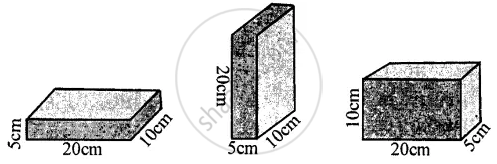
The figure shows a brick of weight 2 kgf and dimensions 20 cm × 10 cm × 5 cm placed in three different positions on the ground. Find the pressure exerted by the brick in each case.
The pressure in a liquid at two points in the same horizontal plane are equal. Consider an elevator accelerating upward and a car accelerating on a horizontal road. The above statement is correct in
An air bubble of radius 0.2 mm is situated just below the water surface. Calculate the gauge pressure. Surface tension of water = 7.2 × 10⁻² N/m.

A water tank has four taps fixed at points A, B, C, D as shown in the following figure. The water will flow out at the same pressure from taps at
Assertion: The pressure at the bottom of the sea is lesser than that near the surface.
Reason: The pressure exerted by a liquid depends upon the depth of the liquid and density of the liquid.
Intermolecular forces are stronger in ______.
Hot air is ______ dense than ordinary air.
