Advertisements
Advertisements
Question
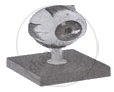
The approximate volume of a human eye is 6.5 cm3. The volume of a laboratory model (excluding base and stand) of the human eye is 1404 cm3.
- State whether the scale factor k is less than, equals to or greater than 1.
- Calculate the:
- value of k
- diameter of the human eye if the radius of the model is 7.2 cm.
- the external surface area of the human eye if the surface area of the model is 651.6 cm2.
Advertisements
Solution
Given: Volume of a human eye = 6.5 cm3, volume of the laboratory model = 1404 cm3; model radius = 7.2 cm; surface area of the model = 651.6 cm2.
Step-wise calculation:
1. Direction of scale factor k
If the model is larger than the real eye (model volume > real volume) then the linear scale k (model length : actual length) is greater than 1.
2. Find k from volumes
Volume scales as k3.
So, `k^3 = V_"model" /V_"actual"`
= `1404/6.5`
Compute 1404 ÷ 6.5 = 216 ...(Since 6.5 × 216 = 1404)
Hence, k3 = 216
⇒ `k = root(3)(216) = 6`.
3. Diameter of the human eye given model radius 7.2 cm.
Linear scale relation: radius_model = k × radiushuman.
So, `"radius"_"human" = "radius"_"model"/k`.
radiushuman = 7.2 ÷ 6 = 1.2 cm.
Diameterhuman = 2 × 1.2 = 2.4 cm.
4. External surface area of the human eye
Surface area scales as k2.
So, `"Area"_"human" = "Area"_"model"/k^2`.
k2 = 62 = 36.
Areahuman = 651.6 ÷ 36
= 18.1 cm2
