Advertisements
Advertisements
Question
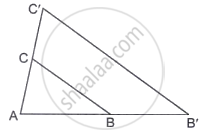
While preparing a Power Point presentation, ΔABC is enlarged along the side BC to ΔAB’C’, as shown in the diagram, such that BC : B’C’ is 3 : 5. Find:
- AB : BB’
- length AB, if BB’ = 4 cm.
- Is ΔABC ~ ΔАВ’C’? Justify your answer.
- ar (ΔABC) : ar (quad. BB’C’C).
Advertisements
Solution
Given: ΔABC is enlarged to ΔAB’C’ with A common and BC : B’C’ = 3 : 5, so the linear scale factor `k = (B’C’)/(BC) = 5/3`.
Step-wise calculation:
1. Relation between AB and BB’:
Because the centre of enlargement is A.
AB’ = k × AB
= `(5/3) AB`
Hence, BB’ = AB’ – AB
= `(5/3 - 1) AB`
= `(2/3) AB`
Therefore, AB : BB’
= `AB : (2/3 AB)`
= 3 : 2
2. Length AB when BB’ = 4 cm:
`BB’ = (2/3)AB = 4`
⇒ `AB = (3/2) xx 4 = 6 cm`
3. Similarity of ΔABC and ΔAB’C’:
Corresponding sides are in the same ratio `k = 5/3 ((AB’)/(AB) = (AC’)/(AC) = (B’C’)/(BC))` and angle A is common.
Thus, ΔABC ∼ ΔAB’C’ triangles are similar by enlargement about A.
4. Area ratio ar(ΔABC) : ar(quad. BB’C’C):
Areas scale by k2, so ar(ΔAB’C’) = k2 × ar(ΔABC)
= `(5/3)^2 xx ar(ΔABC)`
= `25/9 xx ar(ΔABC)`
Quadrilateral BB’C’C = ar(ΔAB’C’) – ar(ΔABC)
= `(25/9 - 1) ar(ΔABC)`
= `16/9 xx ar(ΔABC)`
Therefore, ar(ΔABC) : ar(BB’C’C)
= `1 : 16/9`
= 9 : 16
