Advertisements
Advertisements
Question
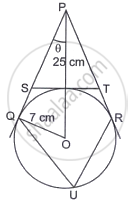
In the adjoining diagram PQ, PR and ST are the tangents to the circle with centre O and radius 7 cm. Given OP = 25 cm.
Find:
- length of ST
- value of ∠OPQ, i.e., θ
- ∠QUR, in nearest degree (use mathematical tables)
Advertisements
Solution
Given: PQ, PR and ST are tangents to the circle with centre O and radius 7 cm; OP = 25 cm.
Step-wise calculation:
1. Length of each tangent PQ and PR:
In right triangle OPQ,
OQ = 7
OP = 25
And OQ ⟂ PQ (radius to tangent)
By Pythagoras: `PQ = sqrt(OP^2 - OQ^2)`
= `sqrt(25^2 - 7^2)`
= `sqrt(625 - 49)`
= `sqrt(576)`
= 24 cm
2. Length ST:
Put O at (0, 0), so the top tangent is y = 7 and P at (0, 25).
Equation of a tangent through P: y = mx + 25.
Tangency condition gives `m^2 = 576/49` so, `m = ±24/7`.
Intersections with y = 7:
`7 = (±24/7) x + 25`
⇒ `x = ±21/4`
= ± 5.25
Thus, `S = (-21/4, 7)`
`T = (21/4, 7)`
And `ST = 21/4 - (-21/4)`
= `21/2`
= 10.5 cm
3. Angle θ = ∠OPQ:
In triangle OPQ right at Q,
`sin θ = (OQ)/(OP)`
= `7/25`
`cos θ = (PQ)/(OP)`
= `24/25`
`tan θ = 7/24`
Hence, `θ = arctan(7/24) ≈ 16.26^circ` (θ ≈ 16.3° to 1 d.p.).
4. Angle ∠QUR:
QOR is the central angle subtended by chord QR.
Using perpendicularity, QOR = 180° – 2θ.
Angle at the circumference on the opposite arc at U is half the central angle:
`∠QUR = 1/2 xx QOR`
= 90° – θ
Numerically ∠QUR = 90° – 16.26° ≈ 73.74°, which to the nearest degree is 74°.
