Advertisements
Advertisements
Question
Use ruler and compass to answer this question. Construct a triangle ABC where AB = 5.5 cm, BC = 4.5 cm and angle ABC = 135°. Construct the circumcircle to the triangle ABC. Measure and write down the length of AC.
Advertisements
Solution
1. Construct triangle ABC
Draw base AB: Use a ruler to draw a line segment AB = 5.5 cm.
Construct angle 135° at B:
1. Extend AB beyond B to form a straight line.
2. Construct a 90° angle at B using arcs bisecting a 180° straight angle.
3. Bisect the adjacent 90° angle the exterior angle to get 45°. Adding this to the. interior 90° or subtracting from 180° results in a 135° angle.
Locate point C: From B, measure 4.5 cm along the 135° line using a compass and mark point C.
Complete the triangle: Join A and C with a ruler.
Find perpendicular bisectors:
1. Use the compass to draw the perpendicular bisector of AB.
2. Draw the perpendicular bisector of BC or AC.
Locate circumcenter (O): The point where these two perpendicular bisectors intersect is the circumcenter O.
Draw the circle: Place the compass point at O and adjust the width to reach vertex A or B or C. Draw the circle passing through all three vertices.
3. Measure AC
Use the ruler to measure the distance between A and C.
Based on the law of cosines b2 + a2 + c2 – 2accos(B), the calculated length is
`AC = sqrt(4.5^2 + 5.5^2 - 2(4.5)(5.5)cos(135^circ)) ≈ 9.25 cm`
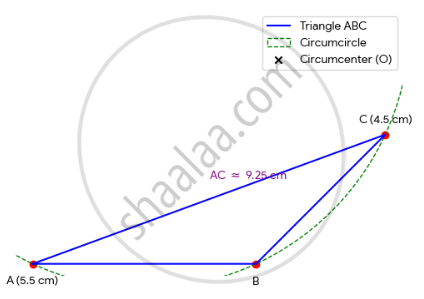
The length of AC is approximately 9.25 cm.
Notes
The answer in the textbook is incorrect.
