Advertisements
Advertisements
Question
The acceleration produced in a body by a force of given magnitude depends on
Options
size of the body
shape of the body
mass of the body
none of these
Advertisements
Solution
The acceleration produced in a body by a force of given magnitude depends on Mass of the body
APPEARS IN
RELATED QUESTIONS
Which force is responsible for the moon revolving round the earth ?
What is the acceleration produced in a freely falling body of mass 10 kg ? (Neglect air resistance)
Fill in the following blank with suitable word :
The acceleration due to gravity on the moon is about ………………of that on the earth.
Explain why, the tip of a sewing needle is sharp.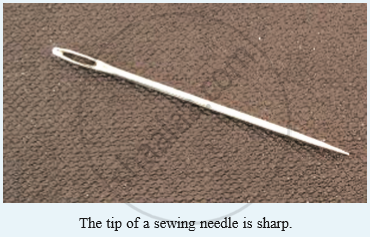
For freely falling object we can write the Newton’s second equation of motion as …..
A car is moving with a uniform velocity 30 ms-1. It is stopped in 2 s by applying a force of 1500 N through its brakes. Calculate the following values : The retardation produced in car.
The value of gravitational acceleration (g) is ______.
Right or wrong sentence.
Free fall of an object does not depend on the mass of the object.
Write a short note.
Free Fall
Calculate the escape velocity on the surface of the moon given the mass and radius of the moon to be 7.34 × 10²² kg and 1.74 × 10⁶ m respectively.
(Given: G = 6.67 × 10⁻¹¹ Nm2/kg2)
