Advertisements
Advertisements
Question
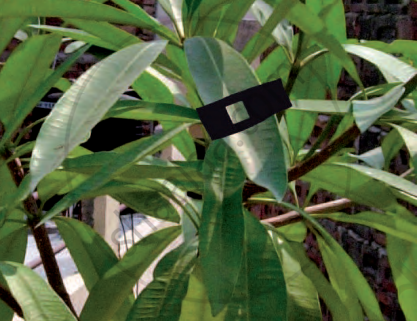
Take a potted plant with broad leaves. Take two strips of black paper and cut out a small square in the centres. Cover a part of two leaves with these papers and secure them with paper clips Figure. Keep the plant in sunlight for 2–5 days. Observe the difference in the colour of the covered and the uncovered portions on the leaf. Perform iodine test on this leaf. Did the two parts show different results? Now take second leaf. Remove the strip and expose the covered part to the sunlight for 2–3 days and do the iodine test again. Describe your observations.
Advertisements
Solution
Experiment Observation:
-
Initial Setup:
- A potted plant with broad leaves is taken.
- Two strips of black paper with small squares cut out in the centre are used to cover parts of two leaves, secured with paper clips (as shown in the figure).
- The plant is kept in sunlight for 2-5 days.
-
First Observation:
- Colour Difference: The uncovered portions of the leaves remain green, while the covered portions do not.
- Iodine Test: The uncovered portions turn blue-black, indicating the presence of starch, whereas the covered portions do not change colour, indicating the absence of starch.
-
Second Observation:
- Exposure to Sunlight: The strip is removed from the second leaf, and the previously covered part is exposed to sunlight for 2-3 days.
- Iodine Test: The previously covered part now turns blue-black, indicating the formation of starch after exposure to sunlight.
Conclusion:
- The covered parts of the leaf did not perform photosynthesis and did not produce starch.
- Once exposed to sunlight, the previously covered parts performed photosynthesis and produced starch, as indicated by the iodine test.
This experiment demonstrates that sunlight is essential for photosynthesis and starch production in leaves.
APPEARS IN
RELATED QUESTIONS
Marasmus is due to deficiency of:
(a) Vitamin C
(b) Carbohydrates
(c) Fat
(d) Food
Name the sources of the following:
Sucrose
Classify according to food-type.
Frog
Choose the correct option.
Acinar cells are present in ______.
Choose the correct option.
Which type of teeth are maximum in number in human buccal cavity?
Differentiate
Kwashiorkar from Marasmus
Can you give me a name?
Solve the following riddles by writing the name of the organism and its mode of nutrition. One riddle is solved to help you.
I am small and I can fly. I disturb your sleep, bite you and suck your blood which is my food. ______, ______
Which of the following food items does not provide any nutrient?
‘Water does not provide nutrients, yet it is an important component of food’. Explain.
