Advertisements
Advertisements
प्रश्न
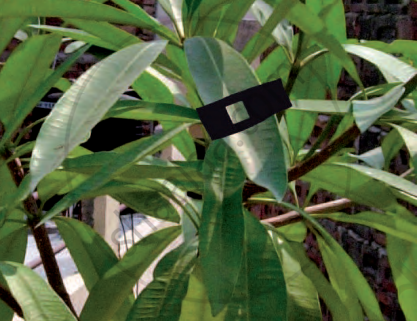
Take a potted plant with broad leaves. Take two strips of black paper and cut out a small square in the centres. Cover a part of two leaves with these papers and secure them with paper clips Figure. Keep the plant in sunlight for 2–5 days. Observe the difference in the colour of the covered and the uncovered portions on the leaf. Perform iodine test on this leaf. Did the two parts show different results? Now take second leaf. Remove the strip and expose the covered part to the sunlight for 2–3 days and do the iodine test again. Describe your observations.
Advertisements
उत्तर
Experiment Observation:
-
Initial Setup:
- A potted plant with broad leaves is taken.
- Two strips of black paper with small squares cut out in the centre are used to cover parts of two leaves, secured with paper clips (as shown in the figure).
- The plant is kept in sunlight for 2-5 days.
-
First Observation:
- Colour Difference: The uncovered portions of the leaves remain green, while the covered portions do not.
- Iodine Test: The uncovered portions turn blue-black, indicating the presence of starch, whereas the covered portions do not change colour, indicating the absence of starch.
-
Second Observation:
- Exposure to Sunlight: The strip is removed from the second leaf, and the previously covered part is exposed to sunlight for 2-3 days.
- Iodine Test: The previously covered part now turns blue-black, indicating the formation of starch after exposure to sunlight.
Conclusion:
- The covered parts of the leaf did not perform photosynthesis and did not produce starch.
- Once exposed to sunlight, the previously covered parts performed photosynthesis and produced starch, as indicated by the iodine test.
This experiment demonstrates that sunlight is essential for photosynthesis and starch production in leaves.
APPEARS IN
संबंधित प्रश्न
Spot the following in the table of vitamins and minerals.
Foods required to prevent the above diseases.
Pulses are a very good source of ______.
Give reasons.
Butterflies have a long tube-like proboscis.
The nutrient required in trace amounts to accomplish various body functions is ______.
In the absence of which of the following will photosynthesis not occur in leaves?
Which of the following raw material is available in the air for photosynthesis?
Fill in the blanks of the paragraph given below with the words provided in the box.
| chlorophyll, energy, food, carbon dioxide, water, photosynthesis |
Leaves have a green pigment called ___(a)___ which captures ___(b)___ from sunlight. This ___(c)___ is used in the process of ___(d)___ and along with other raw materials like ___(e)___ and ___(f)___ synthesize ___(f)___.
Tasty food is not always nutritious and nutritious food may not always be tasty to eat. Comment with examples.
‘Water does not provide nutrients, yet it is an important component of food’. Explain.
What do we actually mean when we say that the "enzymes are specific in their action"?
