Advertisements
Advertisements
Question
Study the graphs given below for Case 1 and Case 2 showing different levels of certain hormones and answer the question that follows:
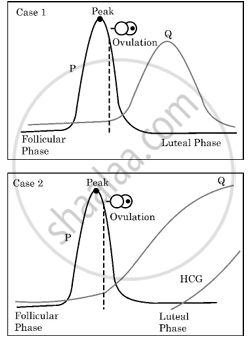
- Which hormone is responsible for the peak observed in Case 1 and Case 2? Write one function of that hormone.
- Write changes that take place in the ovary and uterus during follicular phase.
- Name the hormone Q of Case 2. Write one function of hormone Q.
OR - Which structure in the ovary will remain functional in Case 2? How is it formed?
Case Study
Advertisements
Solution
The given graphs show hormonal regulation in the menstrual cycle.
- The luteinizing hormone (LH) is shown by the peak in Cases 1 and 2.
Function of LH: Around the fourteenth day of the cycle, LH causes the Graafian follicle to release the egg, or ovulate. Additionally, it promotes the follicle’s transition into the corpus luteum. - The follicular phase occurs from Day 6 to Day 14 of the menstrual cycle.
- Ovarian changes:
- Follicle-stimulating hormone, or FSH, promotes the formation of follicles.
- A Graafian follicle develops from the main follicle.
- Just prior to ovulation, there is an increase in LH due to an increase in estrogen release.
- Uterine Changes:
- As estrogen levels rise, the endometrial lining thickens.
- Increased vascularization takes place in anticipation of the embryo’s possible implantation following fertilization.
- Ovarian changes:
- Hormone Q in case 2 is progesterone.
Function: By preserving the endometrial lining, it ensures the uterus is ready for implantation and embryo development.
OR - Corpus luteum remains functional in Case 2.
Formation: Under the influence of LH, the ruptured Graafian follicle changes into the corpus luteum following ovulation. Progesterone, which is secreted by the corpus luteum, is necessary to sustain pregnancy. The corpus luteum degenerates in the absence of fertilization, leading to a decline in progesterone and the onset of menstruation.
shaalaa.com
Is there an error in this question or solution?
