Advertisements
Advertisements
Question
State whether true or false. If false, correct the statement.
Metals can gain electrons.
Options
True
False
Advertisements
Solution
False.
Correct Statement: Metals tend to lose electrons to attain Noble Gas electron configuration.
APPEARS IN
RELATED QUESTIONS
The element which forms a basis oxide has the atomic number of:
(a) 18
(b) 17
(c) 14
(d) 19
An element X from group 2 reacts with element Y from group 16 of the periodic table.
(a) What is the formula of the compound formed?
(b) What is the nature of bond in the compound formed?
The non-metal A is an important constituent of our food and most of the fuels around us. A forms two oxides B and C. The oxide B is poisonous whereas oxide C causes global warming.
(a) Identify A, B and C.
(b) To which group of periodic table does A belong?
(c) Name another element which is placed in the same group as A.
Rearrange the columns 2 and 3 so as to match with the column 1.
| Column 1 | Column 2 | Column 3 |
| i. Triad | a. Lightest and negatively charged particle in all the atoms | 1. Mendeleev |
| ii. Octave | b. Concentrated mass and positive charge | 2. Thomson |
| iii. Atomic number | c. Average of the first and the third atomic mass | 3. Newlands |
| iv. Period | d. Properties of the eighth element similar to the first | 4. Rutherford |
| v. Nucleus | e. Positive charge on the nucleus | 5. Dobereiner |
| vi. Electron | f. Sequential change in molecular formulae | 6. Moseley |
What is the need for classification of elements?
How did the early chemists classify elements?
Moseley’s periodic table is based on atomic mass.
What is the atomic number of elements of period 3 and group 17 of the Periodic Table?
What type of oxide would Eka– aluminium form?
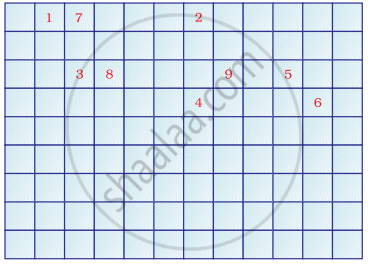
Complete the following cross word puzzle
Across:
(1) An element with atomic number 12.
(3) Metal used in making cans and member of Group 14.
(4) A lustrous non-metal which has 7 electrons in its outermost shell.
Down:
(2) Highly reactive and soft metal which imparts yellow colour when subjected to flame and is kept in kerosene.
(5) The first element of second Period
(6) An element which is used in making fluorescent bulbs and is second member of Group 18 in the Modern Periodic Table
(7) A radioactive element which is the last member of halogen family.
(8) Metal which is an important constituent of steel and forms rust when exposed to moist air.
(9) The first metalloid in Modern Periodic Table whose fibres are used in making bullet-proof vests