Advertisements
Advertisements
Question
Give a reason why elements need to be properly classified.
Advertisements
Solution
Reason of classification of elements:
- It makes the study of elements in an organized manner.
- To help and correlate the properties of elements with the fundamental properties of different states of matter.
- To help to define the relationship of one element with others.
APPEARS IN
RELATED QUESTIONS
Atoms of eight elements A, B, C, D, E, F, G and H have the same number of electron shells but different number of electrons in their outermost shells. It was found that elements A and G combine to form an ionic compound. This ionic compound is added in a small amount to almost all vegetables and dishes during cooking. Oxides of elements A and B are basis in nature while those of elements E and F acidic. The oxide of element D is, however, almost neutral. Based on the above information, answer the following questions:
(a) To which group or period of the periodic table do these elements belong?
(b) What would be the nature of compound formed by a combination of elements B and F?
(c) Which two of these elements could definitely be metals?
(d) Which one of the eight elements is most likely to be found in gaseous state at room temperature?
(e) If the number of electrons in the outermost shell of elements C and G be 3 and 7 respectively, write formula of the compound formed by the combination of C and G.
The elements Li, Na and K, each having one valence electron, are in period 2, 3 and 4 respectively of modern periodic table.
(i) In which group of the periodic table should they be ?
(ii) Which one of them is least reactive ?
(iii) Which one of them has the largest atomic radius ? Give reason in justify your answer in each case.
Alkaline earth metals have valency 2. This means that their position in the modern periodic table is in ______.
The molecular formula of the chloride of element X is XCl. This compound is a solid having a high melting point. Which of the following elements be present in the same group as X.
What is the need for classification of elements?
If the distance between two Cl atoms in a Cl2 molecule is 1.98Å, then the radius of the Cl atom is ______.
Consider the following elements 20Ca, 8Or 18Ar, 16S, 4Be, 2He
Which of the above elements would you expect to be in group 16 of the Periodic Table?
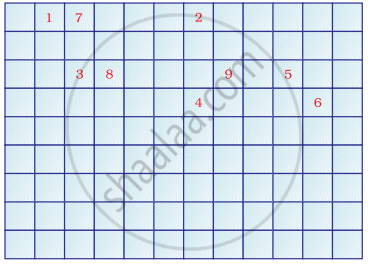
Complete the following cross word puzzle
Across:
(1) An element with atomic number 12.
(3) Metal used in making cans and member of Group 14.
(4) A lustrous non-metal which has 7 electrons in its outermost shell.
Down:
(2) Highly reactive and soft metal which imparts yellow colour when subjected to flame and is kept in kerosene.
(5) The first element of second Period
(6) An element which is used in making fluorescent bulbs and is second member of Group 18 in the Modern Periodic Table
(7) A radioactive element which is the last member of halogen family.
(8) Metal which is an important constituent of steel and forms rust when exposed to moist air.
(9) The first metalloid in Modern Periodic Table whose fibres are used in making bullet-proof vests
Relate the names of the following scientists with the statements given below.
Arranged elements in the increasing order of atomic mass.
Complete the following triads by inserting the missing elements.
Ca, ______, Ba
