Advertisements
Advertisements
Question
State the nature of compounds formed when group 17 elements combine with (i) metals (ii) non-metals.
Advertisements
Solution
- Group 17 elements react with metals to form metal halides which are neutral in nature.
- Group 17 elements react with non-metals to form acidic compounds such as hydrogen halides.
APPEARS IN
RELATED QUESTIONS
Fill in the blank in the following statement:
On going down in a group in the periodic table, the metallic character of elements ...............
Why do elements in the same group show similar properties but the elements in different groups show different properties?
State one reason for keeping fluorine and chlorine in the same of the periodic table.
Correct the statements.
Elements in the same periods have equal valency.
An element X belong to 3rd periods and group II of the periodic table state:
the number of valence electrons,
An element 'X' (Atomic number – 20) burns in the presence of oxygen to form a basic oxide.
(a) Identify the element and write its electronic configuration.
(b) State its group number and period number in the Modern Periodic Table.
(c) Write a balanced chemical equation for the reaction when this oxide is dissolved in water.
What is meant by periodicity of elements?
The following table represents the first period of the modern periodic table. Study the table and answer the questions that follow: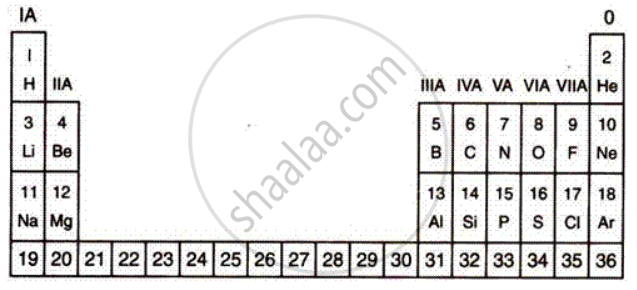
- Write the formula of the sulphate of the element with atomic number 13.
- What type of bonding will be present in the oxide of the element with atomic number 1?
- Which feature of the atomic structure accounts for the similarities in the chemical properties of the elements in group VIIA of the periodic table?
- Name the element which has the highest ionization potential.
- How many electrons are present in the valence shell of the element with atomic number 18?
- What is the name given to the energy released, when an atom in its isolated gaseous state accepts an electron to form an anion?
- What is the electronic configuration of the element in the third period which gains one electron to become an anion?
- Fill in the blanks:
The atomic size ______ as we move from left to right across the period, because the ______ increases, but the ______ remains the same.
An element Z has atomic number 16. Answer the following
(a) State the period and group to which Z belongs
(b) Is Z a metal or a non-metal?
(c) State the formula between Z and hydrogen.
(d) what kind of a compund is this?
State the property trends in general of elements on moving from left to right in a period of the periodic table.
