Advertisements
Advertisements
Question
State the law that explains the heating effect of current with respect to the measurable properties in an electrical circuit.
Advertisements
Solution
Joule's law of heating states that the heat dissipated across a resistor is directly proportional to:
- The square of the current flowing through it.
- The resistance of the conductor.
- Duration of the flow of current.
H = `"I"^2 "Rt"`
APPEARS IN
RELATED QUESTIONS
An electric iron of resistance 20 ohms draws a current of 5 amperes. Calculate the heat produced in 30 seconds.
Derive the expression for the heat produced due to a current 'I' flowing for a time interval 't' through a resistor 'R' having a potential difference 'V' across its ends. With which name is this relation known?
The elements of electrical heating devices are usually made of:
(a) tungsten
(b) bronze
(c) nichrome
(d) argon
An electric iron of 1100 W is operated for 2 hrs daily. What will be the electrical consumption expenses for that in the month of April? (The electric company charges Rs 5 per unit of energy).
Give scientific reason :
In the electric equipment producing heat e.g. iron, electric heater, boiler, toaster, etc., an alloy such as Nichrome is used, not pure metals.
Rewrite the following statement by selecting the correct option:
1 A = ____________ mA.
Why is parallel arrangement used in domestic wiring?
(a) Observe the diagram given below and state whether the bulb will glow or not when we switch on K.
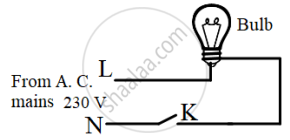
(b) Is it safe to handle the bulb when the switch is OFF?
(c) Give a reason for your answer in (b).
Assertion: A current-carrying wire should be charged.
Reason: The current in a wire is due to the flow of free electrons in a definite direction.
A fuse is used in an electric circuit to stop high currents flowing through the circuit.
