Advertisements
Advertisements
Question
State the empirical laws of static and kinetic friction.
Advertisements
Solution
The empirical laws of friction are:
- Friction is independent of the surface of contact.
- The coefficient of kinetic friction is less than the coefficient of static friction.
- The direction of frictional force is always opposite to the motion of one body over the other.
- Frictional force always acts on the object parallel to the surface on which the object is placed,
- The magnitude of frictional force between any two bodies in contact is directly proportional to the normal reaction between them.
APPEARS IN
RELATED QUESTIONS
Suggest a few methods to reduce friction.
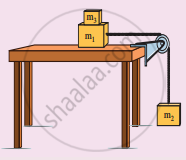
Two masses m1 and m2 are connected with a string passing over a frictionless pulley fixed at the comer of the table as shown in the figure. The coefficient of static friction of mass m1 with the table is µs Calculate the minimum mass m3 that may be placed on m1 to prevent it from sliding. Check if m1 = 15 kg, m2 = 10 kg, m3 = 25 and µs = 0.2.
Briefly explain the origin of friction. Show that in an inclined plane, the angle of friction is equal to the angle of repose.
If a body of mass m is moving on a rough horizontal surface of coefficient of kinetic friction µ, the net resultant force exerted by surface on the body is ______.
A 40 kg wooden crate is being pushed across a wooden floor with a force of 160 N. If µk = 0.3, the acceleration of the crate is ______ m/s2. (g = 10 m/s2}
A block of mass m is pulled by a constant power P placed on a rough horizontal plane. The friction co-efficient between the block and the surface is µ. Maximum velocity of the block will be:
A chain of mass 'M' and length 'L' is put on a rough horizontal surface and is pulled by constant horizontal force 'F' as shown in the figure. The velocity of the chain as it turns completely ______.
(Coefficient of friction = μ)

A body starts from rest on a long inclined plane of slope 45°. The coefficient of friction between the body and the plane varies as µ = 0.3 x, where x is distance travelled down the plane. The body will have maximum speed (for g = 10 m/s2) when x = ______.
There are two inclined surfaces of equal length (L) and same angle of inclination 45° with the horizontal. One of them is rough and the other is perfectly smooth. A given body takes 2 times as much time to slide down, on rough surface than on the smooth surface. The coefficient of kinetic friction (μ) between the object and the rough surface is close to ______.
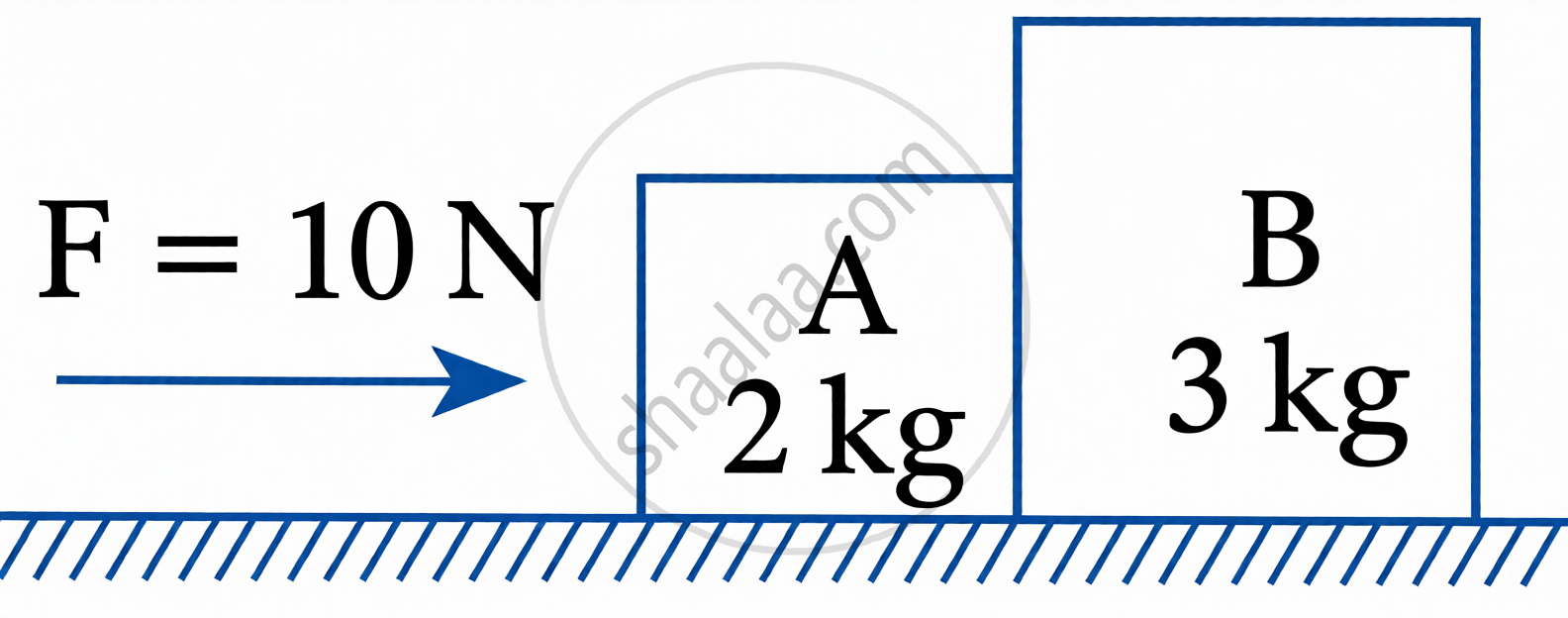
A horizontal force 10 N is applied to a block A as shown in figure. The mass of blocks A and B are 2 kg and 3 kg, respectively. The blocks slide over a frictionless surface. The force exerted by block A on block B is: