Advertisements
Advertisements
Question
Advertisements
Solution
The current flowing through a conductor is directly proportional to the potential difference across its ends, provided the temperature and other physical conditions remain constant.
According to Ohm’s law, the current flowing in a conductor is directly proportional to the potential difference across its ends provided the physical conditions and temperature of conductor remains constant.
APPEARS IN
RELATED QUESTIONS
The SI unit of charge is volt.
Draw the electrical symbols of the following components and state its use:
Rheostat (variable resistance)
Write down the formula which relates electric charge, time and electric current
The p.d. across a 3 Ω resistor is 6 V. The current flowing in the resistor will be:
(a) `1/2A`
(b) 1 A
(c) 2 A
(d) 6 A
A 720 W heater operates from a 220 V line voltage. Calculate:
(a) The electrical energy consumed by the heater in 3 h.
(b) The cost of electrical energy consumption at the rate of 60 paise per kWh.
Fig. shows a 3 pin plug with the cover removed. The electric cable
connected to the plug contains 3 wires with colour coded insulation namely brown, blue and green.
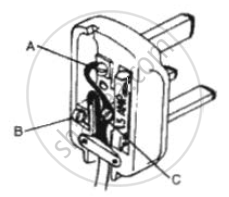
- Identify each of the colour coded wires by stating to which of the
terminals A, B or C in the diagram they should be connected. - Identify the terminal through which no current passes in normal
circumstances. - What is the purpose of the earthed wire connected to an electric
appliance like an electric heater? Describe how it works.
Define the term kilowatt - hour and state its value in S.I. unit.
Calculate the current through a 60 W lamp rated 250 V. If the line voltage falls to 200 V, how is power consumed by the bulb affected?
State the condition when it is advantageous to connect cells in series.
An ammeter is always placed in parallel with the circuit.
