Advertisements
Advertisements
Question
State how electrons are distributed in an atom. Explain in brief the rules which govern their distribution.
Advertisements
Solution
(a) Electrons revolve around the nucleus in imaginary paths called shells or orbits. Shells start from the nucleus to outwards.
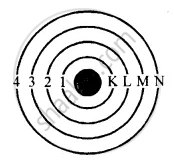
Rules: The maximum number of electrons in a shell is given by 2n2. Where n is the number of shell i.e. 1st shell can have a maximum of 2 electrons.
2n2 = 2(1)2 = 2 × 1 = 2
2nd shell can have maximum of 8 electrons
2n2 = 2(2)2 = 2 × 4 = 8
3rd shell can have maximum of 18 electrons
2n2 = 2 (3)2 = 2 × 9 = 18 and so on….
(b) Outer most orbit cannot have more than 8 electrons and 18 in penultimate orbit.
(c) A new shell cannot start until previous is filled completely.
APPEARS IN
RELATED QUESTIONS
Write true or false for the following statement
The maximum number of electrons in the first shell can be 8.
Give the following a suitable word/phrase.
Protons and neutrons present in the nucleus.
Give the following a suitable word/phrase.
The sum of the number of protons and neutrons of an atom.
WRITE SHORT ANSWER
What is the number of neutrons present in a potassium atom ?
ANSWER IN DETAIL
Name the three subatomic particles. How are they different from each other ?
Name the negatively charged particle present in the atoms of all the elements.
Compare an electron, a proton and a neutron in respect of their relative masses and charges.
Name the sub-atomic particle whose charge is 0.
What is meant by the term subatomic particles?
Write down the names of the particles represented by the following symbols and explain the meaning of superscript and subscript numbers attached.
`""_1"H"^1`, `""_0"n"^1`,`""_(-1)"e"^0`
