Advertisements
Advertisements
प्रश्न
State how electrons are distributed in an atom. Explain in brief the rules which govern their distribution.
Advertisements
उत्तर
(a) Electrons revolve around the nucleus in imaginary paths called shells or orbits. Shells start from the nucleus to outwards.
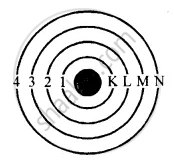
Rules: The maximum number of electrons in a shell is given by 2n2. Where n is the number of shell i.e. 1st shell can have a maximum of 2 electrons.
2n2 = 2(1)2 = 2 × 1 = 2
2nd shell can have maximum of 8 electrons
2n2 = 2(2)2 = 2 × 4 = 8
3rd shell can have maximum of 18 electrons
2n2 = 2 (3)2 = 2 × 9 = 18 and so on….
(b) Outer most orbit cannot have more than 8 electrons and 18 in penultimate orbit.
(c) A new shell cannot start until previous is filled completely.
APPEARS IN
संबंधित प्रश्न
Give the following a suitable word/phrase.
Protons and neutrons present in the nucleus.
Give the following a suitable word/phrase.
The sum of the number of protons and neutrons of an atom.
Multiple Choice Questions
number of valence electrons present in magnesium is
FILL IN THE BLANK
The electrons revolving in shells close to the nucleus are called ................... electrons.
ANSWER IN DETAIL
Name the three subatomic particles. How are they different from each other ?
Draw the electronic configuration of the following elements clearly stating the number of neutrons and protons in their nucleus.
a. Beryllium b. Silicon
c. Chlorine d. Aluminium
e. Nitrogen
Fill in the blank of the following statement :
The electron has _________ charge, the proton has _________ charge, and the neutron has _________ charge.
Compare a proton and a neutron in respect of mass and charge.
Explain how the modern atomic theory contradicted Dalton’s atomic theory.
Explain in brief – Goldstein’s experiment which led to the discovery of the proton.
