Advertisements
Advertisements
Question
State Gauss’s law on electrostatics and drive expression for the electric field due to a long straight thin uniformly charged wire (linear charge density λ) at a point lying at a distance r from the wire.
Advertisements
Solution
Gauss' Law states that the net electric flux through any closed surface is equal to `1/epsilon_0` times the net electric charge within that closed surface.
`oint vec" E".d vec" s" = (q_(enclosed))/epsilon_o`
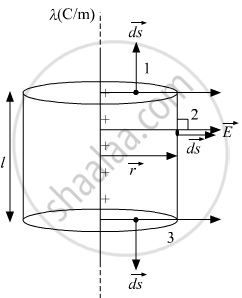
In the diagram, we have taken a cylindrical gaussian surface of radius = r and length = l.
The net charge enclosed inside the gaussian surface `q_(enclosed) = lambdal`
By symmetry, we can say that the Electric field will be in radially outward direction.
According to gauss' law,
`oint vec"E".d vec"s" = q_(enclosed)/epsilon_o`
`int_1 vec"E" .d vec"s" + int_2 vec"E" .d vec"s" + int_3 vec"E". d vec"s" = (lambdal)/epsilon_o`
`int_1 vec"E". d vec"s" & int_3 vec"E". d vec"s" "are zero", "Since" vec"E" "is perpendicular to" d vec"s"`
`int_2 vec"E" . d vec"s" = (lambdal)/epsilon_o`
`"at" 2, vec"E" and d vec"s" "are in the same direction, we can write"`
`E.2pirl = (lambdal)/epsilon_o`
`E = lambda/(2piepsilon_o r)`
APPEARS IN
RELATED QUESTIONS
A thin conducting spherical shell of radius R has charge Q spread uniformly over its surface. Using Gauss’s law, derive an expression for an electric field at a point outside the shell.
Draw a graph of electric field E(r) with distance r from the centre of the shell for 0 ≤ r ≤ ∞.
A charge Q is placed at the centre of a cube. Find the flux of the electric field through the six surfaces of the cube.
The Gaussian surface ______.
The surface considered for Gauss’s law is called ______.
If `oint_s` E.dS = 0 over a surface, then ______.
- the electric field inside the surface and on it is zero.
- the electric field inside the surface is necessarily uniform.
- the number of flux lines entering the surface must be equal to the number of flux lines leaving it.
- all charges must necessarily be outside the surface.
An arbitrary surface encloses a dipole. What is the electric flux through this surface?
In 1959 Lyttleton and Bondi suggested that the expansion of the Universe could be explained if matter carried a net charge. Suppose that the Universe is made up of hydrogen atoms with a number density N, which is maintained a constant. Let the charge on the proton be: ep = – (1 + y)e where e is the electronic charge.
- Find the critical value of y such that expansion may start.
- Show that the velocity of expansion is proportional to the distance from the centre.
A charge Q is placed at the centre of a cube. The electric flux through one of its faces is ______.
