Advertisements
Advertisements
Question
State briefly, how and why the atmospheric pressure of a place varies with the altitude. Draw an approximate graph to illustrate this variation.
Answer in Brief
Advertisements
Solution
- We know atmospheric pressure = height of air column x density of air x acceleration due to gravity; P = hρg So, as we go up i.e. at higher altitudes, the height of air column and hence atmospheric pressure decreases.
- Also with the increase in altitude, the density of air decreases, and hence atmospheric pressure decreases.
If we take the average density of air as 1.29 kgm−3 and the density of mercury as 13600 kgm−3
we can find the height
A column which will exert as much pressure as is exerted by 1 cm or (0.01 m) column of mercury as
Height of air column × density of air = height of mercury column × density of mercury height of air column × 1.29 kg/m3
= 0.01 m × 13600 kg/m3
∴ Height of air column = `136/1.29` m = 105 m (approx).
Thus, 105 m of the air column, on the average, will exert as much pressure as a 1 cm column of mercury. Further,1 cm of mercury column exerts pressure = 105 m of air column 76 cm of mercury column exerts pressure = 105 x 76 m = 7980 m = 8 km (approx).
Thus, 8 km of air column will exert as much pressure as 76 cm of a mercury column. However, it does not mean that atmosphere extends to only 8 km. As it is pointed out earlier, the density of the atmosphere also changes with height. Thus, a fall of one cm in pressure does not mean that we have covered a vertical height of 105 m. On higher altitudes, the vertical height of air is far in excess of 105 m, because of low density of air. A graph showing a fall in pressure with height is shown in the figure.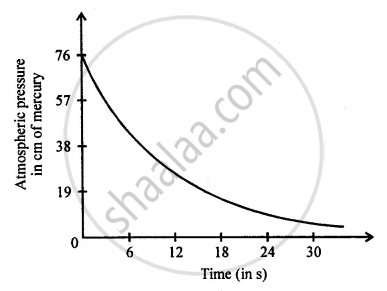
shaalaa.com
Is there an error in this question or solution?
APPEARS IN
RELATED QUESTIONS
Illustrate with the help of a labelled diagram of a simple barometer that the atmospheric pressure at a place is 76 cm of Hg.
Convert 1 mm of Hg into pascal. Take density of Hg = 13.6 x 10³ kg m-3 and g = 9.8 m s-2 .
Briefly explain the three chief types of winds.
The atmospheric pressure is 75 cm of mercury. Express it in Nm-2.
What physical quantity is measured in the bar?
Why is mercury used in a barometer?
The value of the atmospheric pressure at sea level is
Define one atmosphere.
Clouds float in atmosphere because of their low ______.
What is referred to as atmospheric pressure?
