Advertisements
Advertisements
Question
State and write the mathematical expression for Dalton’s law of partial pressure and explain it with a suitable example.
Advertisements
Solution
Dalton’s law of partial pressure:
- Statement: The total pressure of a mixture of two or more non-reactive gases is the sum of the partial pressures of the individual gases in the mixture.
- Explanation:
Dalton’s law can be mathematically expressed as:
PTotal = P1 + P2 + P3 …(at constant T and V)
where, PTotal is the total pressure of the mixture and P1, P2, P3, … are the partial pressures of individual gases 1, 2, 3, … in the mixture.
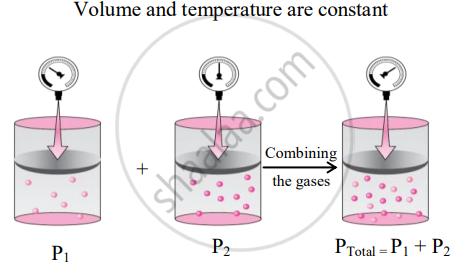
For example, consider two non-reactive gases A and B. On mixing the two gases, the pressure exerted by individual gas A in the mixture of both the gases is called partial pressure of gas A (say P1). Likewise, the partial pressure of gas B is P2. According to Dalton’s law, the total pressure of the mixture of gas A and B at constant T and V will be given as:
PTotal = P1 + P2 - Schematic illustration of Dalton’s law of partial pressures:
APPEARS IN
RELATED QUESTIONS
Answer in one sentence.
The pressure that each individual gas would exert if it were alone in the container, what do we call it as?
If the density of a gas is measured at constant temperature and pressure then which of the following statement is correct?
Would it be easier to drink water with a straw on the top of Mount Everest or at the base? Explain.
Solve the following.
Nitrogen gas is filled in a container of volume 2.32 L at 32°C and 4.7 atm pressure. Calculate the number of moles of the gas.
Solve the following.
At 25°C and 760 mm of Hg pressure, a gas occupies 600 mL volume. What will be its pressure at the height where the temperature is 10°C and the volume of the gas 640 mL?
When an ideal gas undergoes unrestrained expansion, no cooling occurs because the molecules
The value of the gas constant R is
What are ideal gases?
Give a suitable explanation for the following facts about gases.
Gases don’t settle at the bottom of a container
Why do astronauts have to wear protective suits when they are on the surface of the moon?
Argon is an inert gas used in light bulbs to retard the vaporization of the tungsten filament. A certain light bulb containing argon at 1.2 atm and 18°C is heated to 85°C at constant volume. Calculate its final pressure in atm.
A combustible gas is stored in a metal tank at a pressure of 2.98 atm at 25°C. The tank can withstand a maximum pressure of 12 atm after which it will explode. The building in which the tank has been stored catches fire. Now predict whether the tank will blow up first or start melting? (Melting point of the metal = 1100 K).
At constant temperature, a quantity of an ideal gas occupies 50 mL at 500 mmHg pressure. At what pressure, the volume will be 100 mL?
A cold drink bottle contains 200 mL liquid, in which CO2 is 0.1 molar. Considering CO2 as an ideal gas the volume of the dissolved CO2 at S.T.P is ______.
The unit of ideal gas constant (R) is ____________.
For an ideal gas, at constant temperature and pressure, the volume is ____________.
At a constant pressure, an ideal gas has a volume of 200 cm3 at 25°C. If the gas is cooled to −3°C, what will be the final volume of a gas?
What mass of an oxygen gas will occupy 8.21 L of volume at 1 atm pressure and 400 K temperature?
The density of an ideal gas can be expressed as d = ____________.
Which of the following does not represent the ideal gas equation?
A jar contains a gas and a few drops of water at T K. The pressure in the jar is 830 mm of Hg. The temperature of the jar is reduced by 1%. The vapour pressure of water at two temperatures are 30 and 25 mm of Hg. The new pressure in the jar is ______ mm of Hg.
100 g of an ideal gas is kept in a cylinder of 416 L volume at 27°C under 1.5 bar pressure. The molar mass of the gas is ______ g mol−1.
Gas equation, pV = nRT is obeyed by a gas in ______.
The graph of volume (V) versus absolute temperature (T) at constant pressure is ______.
A pressure cooker works on the principle of ______.
A tyre of a vehicle is filled with air having pressure 270 kPa at 27°C. The air pressure in the tyre when the temperature increases to 37°C is ______.
