Advertisements
Advertisements
Question
Solve the following numerical problem.
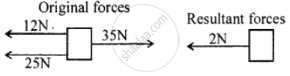
Two force of 12 N and 25 N act on a body to the left-hand side, while another force of 35 N acts on it to the right-hand side. Find the resultant of the forces.
Advertisements
Solution
Total forces acting to the left = 12 N + 25 N = 37 N
Force acting to the right = 35 N
The resultant force on the body = difference between the magnitude of the forces = 37 N – 35 N = 2 N
The object will move in the direction in which the force of 37 N is being applied, i.e., the resultant force of 2 N will act to the left.
APPEARS IN
RELATED QUESTIONS
Define the term “weight of a body”
In which case will there be more friction between the truck and the road: when the truck is empty or when it is loaded?
It is difficult to walk on a wet road. Explain.
Tick the most appropriate answer.
Which of the following is not an effect of force?
Answer the following in a word or two or in a sentence.
Which force is responsible for supporting the weight of a book placed on a table?
Answer the following in a word or two or in a sentence.
Name the force that is responsible for the falling of a stone from a height to the ground.
Identify the agent exerting the force, the object on which the force is acting and the effect of the force in the following situation
Taking out ointment from a medicinal tube.
Solve the following numerical problem.
Two horses pull a cart in the same direction with a force of 500 N each. Find the resultant force acting on the cart.
What is momentum? Write its SI unit. Interpret force in terms of momentum. Represent the following graphically
(a) momentum versus velocity when mass is fixed.
(b) momentum versus mass when velocity is constant.
A ball of dough is rolled into a flat chapatti. Name the force exerted to change the shape of the dough.
