Advertisements
Advertisements
Question
What effect can a force produce on a body which is not allowed to move?
Advertisements
Solution
When a force is applied to a body that is not free to move, it gets deformed, i.e., the shape or size of the body changes. Examples include squeezing a rubber ball, which changes its shape, or compressing a spring, which alters its length.
APPEARS IN
RELATED QUESTIONS
Fill in the blank.
Lubricants are used to ..................... friction.
Name the type of force which act in the following case:
A bicycle comes to rest slowly when the cyclist stops pedaling
Which offers more friction on a body: a glass surface or a wooden surface?
It is difficult to walk on a wet road. Explain.
Answer the following in short.
What will happen to an object if two equal forces act on it in opposite directions?
Identify the agent exerting the force, the object on which the force is acting and the effect of the force in the following situation
Taking out ointment from a medicinal tube.
Solve the following numerical problem.
The forces acting on a wooden block are shown in the figure given alongside. Find the resultant of the forces and the direction of the resultant force.
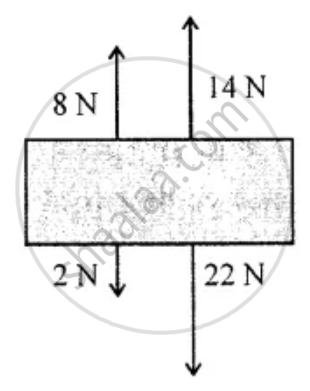
Answer the following in a word or two or in a sentence.
A child tries to slide a wooden block on the top of a table, but she is unable to get a smooth movement. What material do you suggest she should use in between the block and the table to get a smooth movement?
Give a reason for the following.
Vehicles skid on muddy and wet roads. Suggest what type of tires can prevent skidding of vehicles?
What is momentum? Write its SI unit. Interpret force in terms of momentum. Represent the following graphically
(a) momentum versus velocity when mass is fixed.
(b) momentum versus mass when velocity is constant.
