Show that radius (rn) of the nth Bohr orbit varies directly with square of the principal quantum number (n) of the orbit.
Advertisements
Question
Show that radius (rn) of the nth Bohr orbit varies directly with square of the principal quantum number (n) of the orbit.
Advertisements
Solution
Let r be the orbit’s radius, and e, m, and v represent the electron's charge, mass, and velocity, respectively. Z is the atomic number, and the nucleus has a positive charge of +Ze.
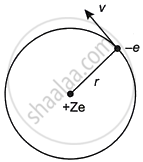
Centripetal force is provided by the electrostatic force of attraction.
Thus,
`(mv^2)/r = 1/(4 pi epsilon_0)`
or mv2 = `(Ze^2)/(4 pi epsilon_0 r)` ...(1)
From Bohr’s quantisation condition, we have oi
mvr = `n h/(2 pi)` ...(2)
n = 1, 2, 3, .... is the principal quantum number.
Squaring equation (2) and dividing by equation (1), we get
`(m^2v^2r^2)/(mv^2) = (n^2h^2//4 pi^2)/(Ze^2//4 pi epsilon_0 r)`
⇒ r = `(n^2h^2epsilon_0)/(pi m Ze^2)`
Since h, ε0, m, Z, and e are constants for an element.
Thus, rn ∝ n2
