Advertisements
Advertisements
Question
Show that in case of a body falling freely under gravity, total mechanical energy remains conserved (neglect air resistance).
Advertisements
Solution
Let a body of mass m fall freely under gravity from height h above the ground.
Let A, B, and C be the positions of the body.
Let x be the distance fallen from A to B.
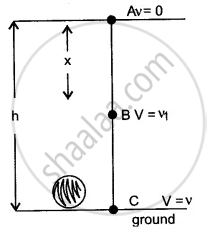
At position A :
KE = 0 .......(body is at rest)
and PE = mgh
∴ Total energy = 0 + mgh = mgh ..........(i)
At position B :
Let v1 be velocity of body, then u = 0, S = x.
From equation v2 = u2 + 2aS
v12 = 0 + 2gx = 2gx
Since KE =`1/2` mv2 = `1/2` m × 2gx = mgx
and PE = mg (h − x)
= mgh − mgx
∴ Total energy = mgx + mgh − mgx = mgh ..............(ii)
At position C :
Let velocity of body be v, then u = 0, S = h.
From equation v2 = u2 + 2gS
v2 = 0 + 2gh = 2gh
Since KE = `1/2` mv2 = `1/2` m × 2gh = mgh
and PE = 0
∴ Total energy = mgh + 0 = mgh ............(iii)
From (i), (ii) and (iii) it is clear that sum of mechanical energy remains same at any point in the path of free fall of a body.
RELATED QUESTIONS
Fill in the blank
The energy possessed by a body due to its motion is called ______ energy.
Select the correct alternatives
The energy stored in an electric cell is
Name the type of energy (kinetic or potential) possessed by the following:
A compressed spring.
Give one relevant example for the following transformation of energy:
Electrical energy to mechanical energy.
Give one relevant example for the following transformations of energy:
Chemical energy to heat energy.
Differentiate between the potential energy (U) and the kinetic energy (K).
What is solar energy?
State the energy changes which take place when:
A body thrown vertically upwards from the ground.
State the energy changes which take place when:
Burning of coal.
