Advertisements
Advertisements
प्रश्न
Show that in case of a body falling freely under gravity, total mechanical energy remains conserved (neglect air resistance).
Advertisements
उत्तर
Let a body of mass m fall freely under gravity from height h above the ground.
Let A, B, and C be the positions of the body.
Let x be the distance fallen from A to B.
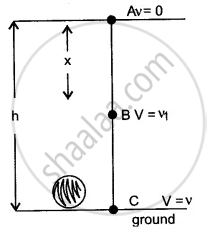
At position A :
KE = 0 .......(body is at rest)
and PE = mgh
∴ Total energy = 0 + mgh = mgh ..........(i)
At position B :
Let v1 be velocity of body, then u = 0, S = x.
From equation v2 = u2 + 2aS
v12 = 0 + 2gx = 2gx
Since KE =`1/2` mv2 = `1/2` m × 2gx = mgx
and PE = mg (h − x)
= mgh − mgx
∴ Total energy = mgx + mgh − mgx = mgh ..............(ii)
At position C :
Let velocity of body be v, then u = 0, S = h.
From equation v2 = u2 + 2gS
v2 = 0 + 2gh = 2gh
Since KE = `1/2` mv2 = `1/2` m × 2gh = mgh
and PE = 0
∴ Total energy = mgh + 0 = mgh ............(iii)
From (i), (ii) and (iii) it is clear that sum of mechanical energy remains same at any point in the path of free fall of a body.
संबंधित प्रश्न
Fill in the blank
Energy possessed by a compressed spring is ______ energy.
Name the type of energy (kinetic or potential) possessed by the following:
A moving cricket ball.
Name the physical quantity measured in terms of horse power.
What is ocean? Explain in brief.
What is wind energy?
What do you understand by the potential energy of the body?
Write the type of energy possessed in the following case:
A wound-up spring
State the energy changes which take place when:
A magnesium ribbon burns in air.
Give one example when:
Light energy changes to chemical energy.
Geothermal energy is:
