Advertisements
Advertisements
Question
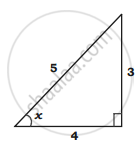
Show that `2sin^-1(3/5) = tan^-1(24/7)`
Advertisements
Solution

Let x = `sin^(-1)(3/5)`
sin x = `3/5`
tan x = `(3/4)`
x = `tan^(-1)(3/4)`
`sin^(-1)(3/5) = tan^(-1)(3/4)`
`2sin^(-1)(3/5) = 2tan^(-1)(3/4)`
= `tan^(-1)(3/4) + tan^(-1)(3/4)`
= `tan^(-1)(((3/4) + (3/4))/(1 - 3/4(3/4)))`
= `tan^(-1)((6/4)/(7/16))`
= `tan^(-1)(6/4 xx 16/7)`
= `tan^(-1)(24/7)`
`sin^(-1)(3/5) = tan^(-1)(24/7)`
APPEARS IN
RELATED QUESTIONS
Show that:
`cos^(-1)(4/5)+cos^(-1)(12/13)=cos^(-1)(33/65)`
Prove that:
`tan^-1 ((sqrt(1 + x) - sqrt(1 - x))/(sqrt(1 + x) + sqrt(1 - x))) = pi/4 - 1/2 cos^-1 x`, for `- 1/sqrt2 ≤ x ≤ 1`
[Hint: Put x = cos 2θ]
`sin^-1 1/2-2sin^-1 1/sqrt2`
Find the set of values of `cosec^-1(sqrt3/2)`
Evaluate the following:
`cot^-1 1/sqrt3-\text(cosec)^-1(-2)+sec^-1(2/sqrt3)`
Evaluate the following:
`cot^-1{2cos(sin^-1 sqrt3/2)}`
Evaluate the following:
`tan^-1(-1/sqrt3)+cot^-1(1/sqrt3)+tan^-1(sin(-pi/2))`
Solve for x:
`tan^-1 [(x-1),(x-2)] + tan^-1 [(x+1),(x+2)] = x/4`
In ΔABC, if a = 18, b = 24, c = 30 then find the values of cosA
In ΔABC, if a = 18, b = 24, c = 30 then find the values of sin `(A/2)`.
In ΔABC prove that `sin "A"/(2). sin "B"/(2). sin "C"/(2) = ["A(ΔABC)"]^2/"abcs"`
Find the principal value of the following: `sin^-1 (1/2)`
Find the principal value of the following: cosec- 1(2)
Find the principal value of the following: tan- 1( - √3)
Evaluate the following:
`tan^-1 sqrt(3) - sec^-1 (-2)`
Prove the following:
`tan^-1["cosθ + sinθ"/"cosθ - sinθ"] = pi/(4) + θ, if θ ∈ (- pi/4, pi/4)`
Prove the following:
`tan^-1[sqrt((1 - cosθ)/(1 + cosθ))] = θ/(2)`, if θ ∈ (– π, π).
In ΔABC, prove the following:
`(cos A)/a + (cos B)/b + (cos C)/c = (a^2 + b^2 + c^2)/(2abc)`
sin−1x − cos−1x = `pi/6`, then x = ______
The principal value of sin−1`(1/2)` is ______
Evaluate cot(tan−1(2x) + cot−1(2x))
Prove that sin `[tan^-1 ((1 - x^2)/(2x)) + cos^-1 ((1 - x^2)/(1 + x^2))]` = 1
Show that `sin^-1(3/5) + sin^-1(8/17) = cos^-1(36/85)`
Prove that `2 tan^-1 (1/8) + tan^-1 (1/7) + 2tan^-1 (1/5) = pi/4`
Find the principal value of the following:
tan-1 (-1)
Find the principal value of the following:
`sec^-1 (-sqrt2)`
Prove that:
2 tan-1 (x) = `sin^-1 ((2x)/(1 + x^2))`
Solve `tan^-1 2x + tan^-1 3x = pi/4`
Find the principal value of `tan^-1 (sqrt(3))`
A man standing directly opposite to one side of a road of width x meter views a circular shaped traffic green signal of diameter ‘a’ meter on the other side of the road. The bottom of the green signal Is ‘b’ meter height from the horizontal level of viewer’s eye. If ‘a’ denotes the angle subtended by the diameter of the green signal at the viewer’s eye, then prove that α = `tan^-1 (("a" + "b")/x) - tan^-1 ("b"/x)`
The value of cot `(tan^-1 2x + cot^-1 2x)` is ______
lf `sqrt3costheta + sintheta = sqrt2`, then the general value of θ is ______
sin[3 sin-1 (0.4)] = ______.
The value of 2 `cot^-1 1/2 - cot^-1 4/3` is ______
If `sin^-1x + cos^-1y = (3pi)/10,` then `cos^-1x + sin^-1y =` ______
If 2tan-1 (cos x) = tan-1 (cosec2 x), then x = ______.
If sin `(sin^-1 1/3 + cos^-1 x) = 1`, then the value of x is ______.
In a triangle ABC, ∠C = 90°, then the value of `tan^-1 ("a"/("b + c")) + tan^-1("b"/("c + a"))` is ______.
If `3sin^-1((2x)/(1 + x^2)) - 4cos^-1((1 - x^2)/(1 + x^2)) + 2tan^-1((2x)/(1 - x^2)) = pi/3`, then x is equal to ______
The value of `sin^-1(cos (53pi)/5)` is ______
`sin{tan^-1((1 - x^2)/(2x)) + cos^-1((1 - x^2)/(1 + x^2))}` is equal to ______
If `3tan^-1x +cot^-1x = pi`, then xis equal to ______.
Solve for x `tan^-1((1 - x)/(1 + x)) = 1/2 tan^-1x, x > 0`
The domain of the function y = sin–1 (– x2) is ______.
If 2 tan–1(cos θ) = tan–1(2 cosec θ), then show that θ = π 4, where n is any integer.
If `"cos"^-1 "x + sin"^-1 "x" = pi`, then the value of x is ____________.
`"cos"^-1 1/2 + 2 "sin"^-1 1/2` is equal to ____________.
If tan-1 (x – 1) + tan-1 x + tan-1 (x + 1) = tan-1 3x, then the values of x are ____________.
`"sin" ["cot"^-1 {"cos" ("tan"^-1 "x")}] =` ____________.
If `"sin"^-1("x"^2 - 7"x" + 12) = "n"pi, AA "n" in "I"`, then x = ____________.
If `"cot"^-1 (sqrt"cos" alpha) - "tan"^-1 (sqrt "cos" alpha) = "x",` then sinx is equal to ____________.
`"tan"^-1 sqrt3 - "sec"^-1 (-2)` is equal to ____________.
The equation of the tangent to the curve given by x = a sin3t, y = bcos3t at a point where t = `pi/2` is
The number of solutions of sin–1x + sin–1(1 – x) = cos–1x is
sin 6θ + sin 4θ + sin 2θ = 0, then θ =
The inverse of `f(x) = sqrt(3x^2 - 4x + 5)` is
`tan^-1 (1 - x)/(1 + x) = 1/2tan^-1x, (x > 0)`, x then will be equal to.
Find the principal value of `cot^-1 ((-1)/sqrt(3))`
Consider f(x) = sin–1[2x] + cos–1([x] – 1) (where [.] denotes greatest integer function.) If domain of f(x) is [a, b) and the range of f(x) is {c, d} then `a + b + (2d)/c` is equal to ______. (where c < d)
Let x = sin–1(sin8) + cos–1(cos11) + tan–1(tan7), and x = k(π – 2.4) for an integer k, then the value of k is ______.
cos–1(cos10) is equal to ______.
If sin–1a + sin–1b + sin–1c = π, then find the value of `asqrt(1 - a^2) + bsqrt(1 - b^2) + csqrt(1 - c^2)`.
If x ∈ R – {0}, then `tan^-1 ((sqrt(1 + x^2) + sqrt(1 - x^2))/(sqrt(1 + x^2) - sqrt(1 - x^2)))`
The value of cos (2cos–1 x + sin–1 x) at x = `1/5` is ______.
sin [cot–1 (cos (tan–1 x))] = ______.
Find the value of `cos(x/2)`, if tan x = `5/12` and x lies in third quadrant.
The value of `tan(cos^-1 4/5 + tan^-1 2/3)` is ______.
Solve for x:
5tan–1x + 3cot–1x = 2π