Advertisements
Advertisements
प्रश्न
Show that `2sin^-1(3/5) = tan^-1(24/7)`
Advertisements
उत्तर

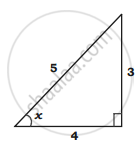
Let x = `sin^(-1)(3/5)`
sin x = `3/5`
tan x = `(3/4)`
x = `tan^(-1)(3/4)`
`sin^(-1)(3/5) = tan^(-1)(3/4)`
`2sin^(-1)(3/5) = 2tan^(-1)(3/4)`
= `tan^(-1)(3/4) + tan^(-1)(3/4)`
= `tan^(-1)(((3/4) + (3/4))/(1 - 3/4(3/4)))`
= `tan^(-1)((6/4)/(7/16))`
= `tan^(-1)(6/4 xx 16/7)`
= `tan^(-1)(24/7)`
`sin^(-1)(3/5) = tan^(-1)(24/7)`
APPEARS IN
संबंधित प्रश्न
If `tan^-1((x-1)/(x-2))+cot^-1((x+2)/(x+1))=pi/4; `
Find the principal value of the following:
`sin^(-1) (-1/2)`
Find the principal value of the following:
cosec−1 (2)
Find the principal value of the following:
`tan^(-1) (-sqrt3)`
Find the principal value of the following:
`cos^(-1) (-1/2)`
Find the principal value of the following:
`"cosec"^(-1)(-sqrt2)`
Find the value of the following:
`tan^(-1)(1) + cos^(-1) (-1/2) + sin^(-1) (-1/2)`
Find the value of the following:
`cos^(-1) (1/2) + 2 sin^(-1)(1/2)`
`tan^(-1) sqrt3 - sec^(-1)(-2)` is equal to ______.
Prove that:
`tan^-1 ((sqrt(1 + x) - sqrt(1 - x))/(sqrt(1 + x) + sqrt(1 - x))) = pi/4 - 1/2 cos^-1 x`, for `- 1/sqrt2 ≤ x ≤ 1`
[Hint: Put x = cos 2θ]
Find the domain of the following function:
`f(x)sin^-1sqrt(x^2-1)`
Evaluate the following:
`cot^-1 1/sqrt3-\text(cosec)^-1(-2)+sec^-1(2/sqrt3)`
Evaluate: tan `[ 2 tan^-1 (1)/(2) – cot^-1 3]`
In ΔABC, if a = 18, b = 24, c = 30 then find the values of cosA
In ΔABC, if a = 18, b = 24, c = 30 then find the values of tan `A/2`
In ΔABC, if a = 18, b = 24, c = 30 then find the values of A(ΔABC)
Find the principal value of the following: sin-1 `(1/sqrt(2))`
Prove the following:
`tan^-1["cosθ + sinθ"/"cosθ - sinθ"] = pi/(4) + θ, if θ ∈ (- pi/4, pi/4)`
Find the principal solutions of the following equation:
sin 2θ = `− 1/(sqrt2)`
The principal value of sin−1`(1/2)` is ______
If `sin(sin^-1(1/5) + cos^-1(x))` = 1, then x = ______
Evaluate:
`sin[cos^-1 (3/5)]`
If tan−1x + tan−1y + tan−1z = π, then show that `1/(xy) + 1/(yz) + 1/(zx)` = 1
Prove that cot−1(7) + 2 cot−1(3) = `pi/4`
Prove that `2 tan^-1 (1/8) + tan^-1 (1/7) + 2tan^-1 (1/5) = pi/4`
Find the principal value of the following:
cosec-1 (2)
Find the principal value of the following:
`sec^-1 (-sqrt2)`
Prove that:
2 tan-1 (x) = `sin^-1 ((2x)/(1 + x^2))`
Prove that:
`tan^-1 (4/3) + tan^-1 (1/7) = pi/4`
Show that `tan^-1 (1/2) + tan^-1 (2/11) = tan^-1 (3/4)`
Solve: tan-1 (x + 1) + tan-1 (x – 1) = `tan^-1 (4/7)`
Evaluate: sin`[1/2 cos^-1 (4/5)]`
Express `tan^-1 [(cos x)/(1 - sin x)], - pi/2 < x < (3pi)/2` in the simplest form.
Choose the correct alternative:
cos 2θ cos 2ϕ+ sin2 (θ – ϕ) – sin2 (θ + ϕ) is equal to
The principle solutions of equation tan θ = -1 are ______
Which of the following function has period 2?
The value of 2 `cot^-1 1/2 - cot^-1 4/3` is ______
`sin^2(sin^-1 1/2) + tan^2 (sec^-1 2) + cot^2(cosec^-1 4)` = ______.
If 2tan-1 (cos x) = tan-1 (cosec2 x), then x = ______.
`tan[2tan^-1 (1/3) - pi/4]` = ______.
The value of cot (- 1110°) is equal to ______.
If `3sin^-1((2x)/(1 + x^2)) - 4cos^-1((1 - x^2)/(1 + x^2)) + 2tan^-1((2x)/(1 - x^2)) = pi/3`, then x is equal to ______
Solve for x `tan^-1((1 - x)/(1 + x)) = 1/2 tan^-1x, x > 0`
The domain of the function y = sin–1 (– x2) is ______.
The domain of y = cos–1(x2 – 4) is ______.
If 2 tan–1(cos θ) = tan–1(2 cosec θ), then show that θ = π 4, where n is any integer.
Show that `cos(2tan^-1 1/7) = sin(4tan^-1 1/3)`
All trigonometric functions have inverse over their respective domains.
`"cos" 2 theta` is not equal to ____________.
If sin-1 x – cos-1 x `= pi/6,` then x = ____________.
If tan-1 3 + tan-1 x = tan-1 8, then x = ____________.
`"sin"^-1 (-1/2)`
If 6sin-1 (x2 – 6x + 8.5) = `pi`, then x is equal to ____________.
`"cos"^-1 ["cos" (2 "cot"^-1 (sqrt2 - 1))] =` ____________.
Find the value of sec2 (tan-1 2) + cosec2 (cot-1 3) ____________.
If a = `(2sin theta)/(1 + costheta + sintheta)`, then `(1 + sintheta - costheta)/(1 + sintheta)` is
sin 6θ + sin 4θ + sin 2θ = 0, then θ =
What is the value of `sin^-1(sin (3pi)/4)`?
Find the principal value of `tan^-1 (sqrt(3))`
Find the value, if sin–1x = y, then `->`:-
`tan^-1 (1 - x)/(1 + x) = 1/2tan^-1x, (x > 0)`, x then will be equal to.
Value of `sin(pi/3 - sin^1 (- 1/2))` is equal to
If f(x) = x5 + 2x – 3, then (f–1)1 (–3) = ______.
Assertion (A): The domain of the function sec–12x is `(-∞, - 1/2] ∪ pi/2, ∞)`
Reason (R): sec–1(–2) = `- pi/4`
`lim_(n→∞)tan{sum_(r = 1)^n tan^-1(1/(1 + r + r^2))}` is equal to ______.
If sin–1a + sin–1b + sin–1c = π, then find the value of `asqrt(1 - a^2) + bsqrt(1 - b^2) + csqrt(1 - c^2)`.
If ax + b (sec (tan–1 x)) = c and ay + b (sec.(tan–1 y)) = c, then `(x + y)/(1 - xy)` = ______.
Derivative of `tan^-1(x/sqrt(1 - x^2))` with respect sin–1(3x – 4x3) is ______.
If cos–1 x > sin–1 x, then ______.
The value of `tan(cos^-1 4/5 + tan^-1 2/3)` is ______.