Advertisements
Advertisements
Question
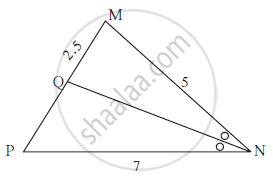
Seg NQ is the bisector of ∠ N
of Δ MNP. If MN= 5, PN =7,
MQ = 2.5 then find QP.
Advertisements
Solution
MN = 5, PN = 7, MQ = 2.5, QP = ?
From the figure `(MN)/(NP)=(MQ)/(QP)`= ..............(Angle bisector theorem)
∴ `5/2.5 = 7/(QP)`
∴ 5 × QP = 7 × 2.5
∴ QP = `(7×2.5)/5`.
∴ QP = 3.5
APPEARS IN
RELATED QUESTIONS
Given below is the triangle and length of line segments. Identify in the given figure, ray PM is the bisector of ∠QPR.
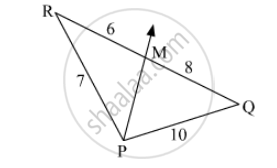
Find QP using given information in the figure.
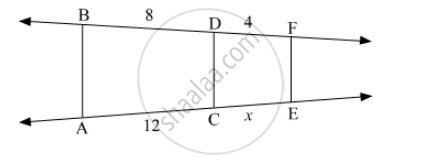
In the given figure, if AB || CD || FE then find x and AE.
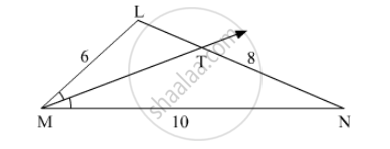
In ∆LMN, ray MT bisects ∠LMN If LM = 6, MN = 10, TN = 8, then Find LT.
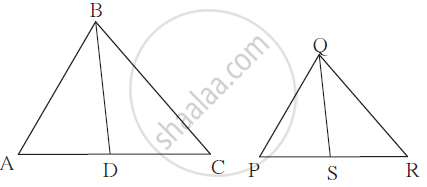
In ∆ABC, seg BD bisects ∠ABC. If AB = x, BC = x + 5, AD = x – 2, DC = x + 2, then find the value of x.

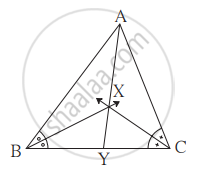
In the given fig, bisectors of ∠B and ∠C of ∆ABC intersect each other in point X. Line AX intersects side BC in point Y. AB = 5, AC = 4, BC = 6 then find `"AX"/"XY"`.
In ▢ABCD, seg AD || seg BC. Diagonal AC and diagonal BD intersect each other in point P. Then show that `"AP"/"PD" = "PC"/"BP"`.

In Δ ABC and Δ PQR,
∠ ABC ≅ ∠ PQR, seg BD and
seg QS are angle bisector.
`If (l(AD))/(l(PS)) = (l(DC))/(l(SR))`
Prove that : Δ ABC ∼ Δ PQR
From the top of a light house, an abserver looking at a boat makes an angle of depression of 600. If the height of the lighthouse is 90 m then find how far is the boat from the lighthouse. (3 = 1.73)

In ΔABC, ∠ACB = 90°. seg CD ⊥ side AB and seg CE is angle bisector of ∠ACB.
Prove that: `(AD)/(BD) = (AE^2)/(BE^2)`.
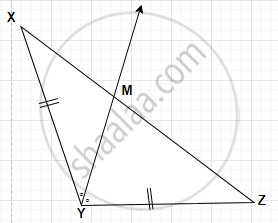
In the figure, ray YM is the bisector of ∠XYZ, where seg XY ≅ seg YZ, find the relation between XM and MZ.
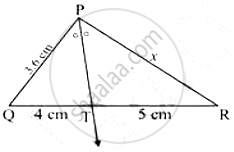
In the following figure, ray PT is the bisector of ∠QPR Find the value of x and perimeter of ∠QPR.
Draw the circumcircle of ΔPMT in which PM = 5.6 cm, ∠P = 60°, ∠M = 70°.
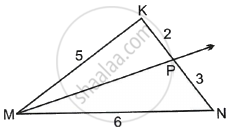
From the information given in the figure, determine whether MP is the bisector of ∠KMN.
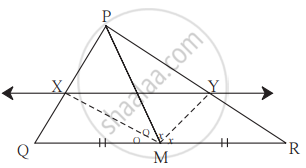
In ∆PQR seg PM is a median. Angle bisectors of ∠PMQ and ∠PMR intersect side PQ and side PR in points X and Y respectively. Prove that XY || QR.
Complete the proof by filling in the boxes.
solution:
In ∆PMQ,
Ray MX is the bisector of ∠PMQ.
∴ `("MP")/("MQ") = square/square` .............(I) [Theorem of angle bisector]
Similarly, in ∆PMR, Ray MY is the bisector of ∠PMR.
∴ `("MP")/("MR") = square/square` .............(II) [Theorem of angle bisector]
But `("MP")/("MQ") = ("MP")/("MR")` .............(III) [As M is the midpoint of QR.]
Hence MQ = MR
∴ `("PX")/square = square/("YR")` .............[From (I), (II) and (III)]
∴ XY || QR .............[Converse of basic proportionality theorem]
