Advertisements
Advertisements
Question
Refer to question 11. How many of circuits of Type A and of Type B, should be produced by the manufacturer so as to maximise his profit? Determine the maximum profit.
Advertisements
Solution
As per the solution of Question No. 11
We have Maximise Z = 50x + 60y
Subject to the contraints
2x + y ≤ 20 ......(i)
x + 2y ≤ 12 .......(ii)
x + 3y ≤ 15 .......(iv)
x ≥ 0, y ≥ 0 .......(iv)
Let us draw the table for the above statements
Table for (i)
| x | 0 | 10 |
| y | 20 | 0 |
Table for (ii)
| x | 0 | 10 |
| y | 20 | 0 |
Table for (ii)
| x | 0 | 15 |
| y | 5 | 0 |
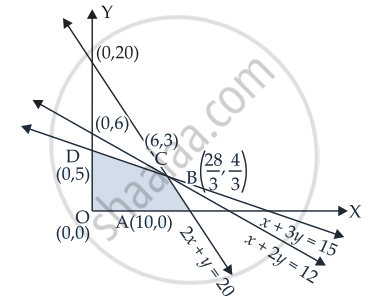
Solving equation (i) and (ii) we get,
x = `28/3`
y = `4/3`
∴ `"B"(38/3, 4/3)` is the corner
Solving equation (ii) and (iii) we get,
x = 6, y = 3
∴ C(6, 3) is the corner
Solving equation (i) and (iii) we get,
x = 9, y = 2 .....(Not included in the feasible region)
Here, OABCD is the feasible region.
So, the corner points are O(0, 0), A(10, 0), `"B"(28/3, 4/3)`, C(6, 3) and D(0, 5).
Let us evaluate the value of Z
| Corner points | Corresponding values of Z = 50x + 60y | |
| O(0, 0) | Z = 50(0) + 60(0) = 0 | |
| A(10, 0) | Z = 50(10) + 60(0) = 500 | |
| `"B"(28/3, 4/3)` |
Z = `50(28/3) + 60(4/3)` = `1400/3 + 240/3` = `1640/3` = 546.6 |
← Maximum |
| C(6, 3) | Z = 50(6) + 60(3) = 480 | |
| D(0, 5) | Z = 50(0) + 60(5) = 300 |
Here, the maximum profit is ₹ 546.6 which is not possible for number of items in fraction.
Hence, the maximum profit for the manufacturer is ₹ 480 at (6, 3).
Type A = 6 and Type B = 3.
