Advertisements
Advertisements
Question
Rakesh can do a piece of work in 20 days. How much work can he do in 4 days?
Advertisements
Solution
\[ \text{ It is given that Rakesh can do a piece of work in 20 days } . \]
\[ \therefore \text{ Rakesh's 1 day's work } = \frac{1}{20}\]
\[ \therefore \text{ Rakesh's workfor 4 days } = \frac{4}{20} = \frac{1}{5}\]
\[ \text{ Thus, he can do } \frac{1}{5}\text{ th of the work in 4 days } . \]
RELATED QUESTIONS
Complite the following table given that x varies directly as y .
| x | 5 | ... | 10 | 35 | 25 | ... |
| y | 8 | 12 | ... | ... | ... | 32 |
A can do a piece of work in 40 days and B in 45 days. They work together for 10 days and then B goes away. In how many days will A finish the remaining work?
If the cost of 3 books is ₹ 90, then find the cost of 12 books.
100 persons had food provision for 24 days. If 20 persons left the place, the provision will last for ______.
x and y are said to vary directly with each other if for some positive number k, ______ = k.
If 45 persons can complete a work in 20 days, then the time taken by 75 persons will be ______ hours.
It is given that l varies directly as m. Find l, when m is 33.
30 persons can reap a field in 17 days. How many more persons should be engaged to reap the same field in 10 days?
Ms. Anita has to drive from Jhareda to Ganwari. She measures a distance of 3.5 cm between these villages on the map. What is the actual distance between the villages if the map scale is 1 cm = 10 km?
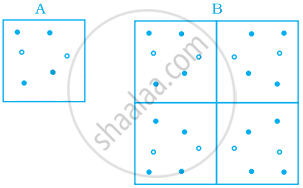
Pattern B consists of four tiles like pattern A. Write a proportion involving red dots and blue dots in pattern A and B. Are they in direct proportion? If yes, write the constant of proportion.