English

Prove That: If the Diagonals of a Quadrilateral Bisect Each Other at Right Angles, Then It is a Rhombus. - Mathematics

Advertisements
Advertisements

Question

Prove that: If the diagonals of a quadrilateral bisect each other at right angles, then it is a rhombus. 

Sum
Advertisements

Solution


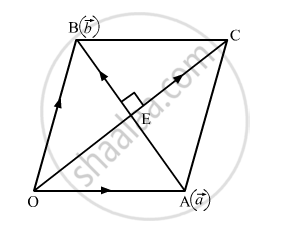
Let OACB be a quadrilateral such that diagonals OC and AB bisect each other at 90º.

Taking O as the origin, let the poisition vectors of A and B be \[\vec{a}\] and \[\vec{b}\]  respectively. 

Then, \[\vec{OA} = \vec{a}\] and \[\vec{OB} = \vec{b}\] Position vector of mid-point of AB, \[\vec{OE} = \frac{\vec{a} + \vec{b}}{2}\] 

∴ Position vector of C, \[\vec{OC} = \vec{a} + \vec{b}\] 

By the triangle law of vector addition, we have 

\[\vec{OA} + \vec{AB} = \vec{OB} \]
\[ \Rightarrow \vec{AB} = \vec{OB} - \vec{OA} = \vec{b} - \vec{a}\] 

Since \[\vec{AB} \perp \vec{OC}\]  

\[\Rightarrow \vec{AB} . \vec{OC} = 0\]

\[ \Rightarrow \left( \vec{b} - \vec{a} \right) . \left( \vec{a} + \vec{b} \right) = 0\]

\[ \Rightarrow \left| \vec{b} \right|^2 - \left| \vec{a} \right|^2 = 0\]

\[ \Rightarrow \left| \vec{a} \right|^2 = \left| \vec{b} \right|^2 \]

\[ \Rightarrow \left| \vec{a} \right| = \left| \vec{b} \right|\]

\[ \Rightarrow OA = OB\] 

In a quadrilateral if diagonals bisects each other at right angle and adjacent sides are equal, then it is a rhombus. 

shaalaa.com
  Is there an error in this question or solution?
Chapter 24: Scalar Or Dot Product - Exercise 24.2 [Page 46]

APPEARS IN

RD Sharma Mathematics [English] Class 12
Chapter 24 Scalar Or Dot Product
Exercise 24.2 | Q 2 | Page 46

RELATED QUESTIONS

If point C `(barc)` divides the segment joining the points A(`bara`) and  B(`barb`) internally in the ratio m : n, then prove that `barc=(mbarb+nbara)/(m+n)`


In a triangle OAB,\[\angle\]AOB = 90º. If P and Q are points of trisection of AB, prove that \[{OP}^2 + {OQ}^2 = \frac{5}{9} {AB}^2\]


(Pythagoras's Theorem) Prove by vector method that in a right angled triangle, the square of the hypotenuse is equal to the sum of the squares of the other two sides. 


Prove using vectors: The quadrilateral obtained by joining mid-points of adjacent sides of a rectangle is a rhombus. 


Prove that the diagonals of a rhombus are perpendicular bisectors of each other. 


If AD is the median of ∆ABC, using vectors, prove that \[{AB}^2 + {AC}^2 = 2\left( {AD}^2 + {CD}^2 \right)\] 


If the median to the base of a triangle is perpendicular to the base, then triangle is isosceles. 


In a quadrilateral ABCD, prove that \[{AB}^2 + {BC}^2 + {CD}^2 + {DA}^2 = {AC}^2 + {BD}^2 + 4 {PQ}^2\] where P and Q are middle points of diagonals AC and BD. 


Prove that a quadrilateral is a parallelogram if and only if its diagonals bisect each other.


Prove that the median of a trapezium is parallel to the parallel sides of the trapezium and its length is half of the sum of the lengths of the parallel sides.


If two of the vertices of a triangle are A (3, 1, 4) and B (– 4, 5, –3) and the centroid of the triangle is at G (–1, 2, 1), then find the coordinates of the third vertex C of the triangle.


If the centroid of a tetrahedron OABC is (1, 2, - 1) where A(a, 2, 3), B(1, b, 2), C(2, 1, c), find the distance of P(a, b, c) from origin.


Find the centroid of tetrahedron with vertices K(5, −7, 0), L(1, 5, 3), M(4, −6, 3), N(6, −4, 2)


The points A, B, C have position vectors `bar"a", bar"b" and bar"c"` respectively. The point P is the midpoint of AB. Find the vector `bar"PC"` in terms of `bar"a", bar"b", bar"c"`.


If D, E, F are the midpoints of the sides BC, CA, AB of a triangle ABC, prove that `bar(AD) + bar(BE) + bar(CF) = bar0`.


Find the volume of a parallelopiped whose coterimus edges are represented by the vectors `hat"i" + hat"k", hat"i" + hat"k", hat"i" + hat"j"`. Also find volume of tetrahedron having these coterminus edges.


If A(5, 1, p), B(1, q, p) and C(1, −2, 3) are vertices of triangle and `"G"("r", -4/3, 1/3)` is its centroid then find the values of p, q and r


Prove that altitudes of a triangle are concurrent


Prove that the angle bisectors of a triangle are concurrent


If G(3, -5, r) is centroid of triangle ABC where A(7, - 8, 1), B(p, q, 5) and C(q + 1, 5p, 0) are vertices of a triangle then values of p, q, rare respectively.


If the position vectors of points A and B are `hati + 8hatj + 4hatk` and `7hati + 2hatj - 8hatk`, then what will be the position vector of the midpoint of AB?


If A, B, C are the vertices of a triangle whose position vectors are `overline("a"),overline("b"),overline("c")` and G is the centroid of the `triangle ABC,` then `overline("GA")+overline("GB")+overline("GC")` is ______.


The co-ordinates of the points which divides line segment joining the point A(2, –6, 8) and B(–1, 3,–4) internally in the ratio 1: 3' are ______.


If G(g), H(h) and (p) are centroid orthocentre and circumcentre of a triangle and xp + yh + zg = 0, then (x, y, z) is equal to ______.


The position vectors of three consecutive vertices of a parallelogram ABCD are `A(4hati + 2hatj - 6hatk), B(5hati - 3hatj + hatk)`, and `C(12hati + 4hatj + 5hatk)`. The position vector of D is given by ______.


The position vector of points A and B are `6 bar "a" + 2 bar "b" and bar "a" - 3 bar"b"`. If the point C divided AB in the ratio 3 : 2, show that the position vector of C is `3 bar "a" - bar "b".`


The position vector of points A and B are `6bara +2barb ` and `bara-3barb `.If the point C divides AB in the ratio 3 : 2 then show that the position vector of C is `3bara-barb` .


Let `A(bara)` and `B(barb)` be any two points in the space and `R(barr)` be the third point on the line AB dividing the segment AB externally in the ratio m : n, then prove that `barr = (mbarb - nbara)/(m - n)`.


The position vector of points A and B are `6bara + 2barb` and `bara - 3barb`. If the point C divides AB in the ratio 3 : 2,  then show that the position vector of C is `3bara - barb`. 


The position vector of points A and B are `6 bara + 2 barb and bara - 3 barb`. If the point C divides AB in the ratio 3 : 2 then show that the position vector of C is `3 bara - barb`.


The position vectors of points A and B are 6`bara` + 2`barb` and `bara - 3barb`. If the point C divides AB in the ratio 3:2, then show that the position vector of C is 3`bara - b`.


Share
Notifications

Englishहिंदीमराठी


      Forgot password?
Use app×