Advertisements
Advertisements
Question
If AD is the median of ∆ABC, using vectors, prove that \[{AB}^2 + {AC}^2 = 2\left( {AD}^2 + {CD}^2 \right)\]
Advertisements
Solution
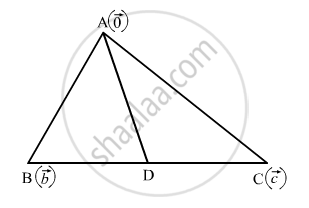
Taking A as the origin, let the position vectors of B and C be \[\vec{b}\] and \[\vec{c}\] respectively.
It is given that AD is the median of ∆ABC.
∴ Position vector of mid-point of BC = \[\vec{AD} = \frac{\vec{b} + \vec{c}}{2}\]................(Mid-point formula)
Now,
\[{AB}^2 + {AC}^2 = \left| \vec{AB} \right|^2 + \left| \vec{AC} \right|^2 = \left| \vec{b} \right|^2 + \left| \vec{c} \right|^2\]
Also,
\[2\left( {AD}^2 + {CD}^2 \right)\]
\[ = 2\left( \left| \vec{AD} \right|^2 + \left| \vec{CD} \right|^2 \right)\]
\[ = 2\left[ \left( \frac{\vec{b} + \vec{c}}{2} \right) . \left( \frac{\vec{b} + \vec{c}}{2} \right) + \left( \frac{\vec{b} + \vec{c}}{2} - \vec{c} \right) . \left( \frac{\vec{b} + \vec{c}}{2} - \vec{c} \right) \right]\]
\[ = 2\left[ \left( \frac{\vec{b} + \vec{c}}{2} \right) . \left( \frac{\vec{b} + \vec{c}}{2} \right) + \left( \frac{\vec{b} - \vec{c}}{2} \right) . \left( \frac{\vec{b} - \vec{c}}{2} \right) \right]\]
\[ = \frac{\left| \vec{b} \right|^2 + 2 \vec{b} . \vec{c} + \left| \vec{c} \right|^2}{2} + \frac{\left| \vec{b} \right|^2 - 2 \vec{b} . \vec{c} + \left| \vec{c} \right|^2}{2}\]
\[ = \frac{2 \left| \vec{b} \right|^2 + 2 \left| \vec{c} \right|^2}{2}\]
\[ = \left| \vec{b} \right|^2 + \left| \vec{c} \right|^2 . . . . . \left( 2 \right)\]
From (1) and (2), we have
\[{AB}^2 + {AC}^2 = 2\left( {AD}^2 + {CD}^2 \right)\]
APPEARS IN
RELATED QUESTIONS
In a triangle OAB,\[\angle\]AOB = 90º. If P and Q are points of trisection of AB, prove that \[{OP}^2 + {OQ}^2 = \frac{5}{9} {AB}^2\]
Prove that: If the diagonals of a quadrilateral bisect each other at right angles, then it is a rhombus.
Prove using vectors: The quadrilateral obtained by joining mid-points of adjacent sides of a rectangle is a rhombus.
Prove that the diagonals of a rhombus are perpendicular bisectors of each other.
In a quadrilateral ABCD, prove that \[{AB}^2 + {BC}^2 + {CD}^2 + {DA}^2 = {AC}^2 + {BD}^2 + 4 {PQ}^2\] where P and Q are middle points of diagonals AC and BD.
Find the position vector of point R which divides the line joining the points P and Q whose position vectors are `2hat"i" - hat"j" + 3hat"k"` and `- 5hat"i" + 2hat"j" - 5hat"k"` in the ratio 3 : 2 is externally.
The position vector of points A and B are `6bar"a" + 2bar"b"` and `bar"a" - 3bar"b"`. If the point C divides AB in the ratio 3 : 2, show that the position vector of C is `3bar"a" - bar"b"`.
If two of the vertices of a triangle are A (3, 1, 4) and B(– 4, 5, –3) and the centroid of the triangle is at G (–1, 2, 1), then find the coordinates of the third vertex C of the triangle.
If the centroid of a tetrahedron OABC is (1, 2, - 1) where A(a, 2, 3), B(1, b, 2), C(2, 1, c), find the distance of P(a, b, c) from origin.
Find the volume of a parallelopiped whose coterimus edges are represented by the vectors `hat"i" + hat"k", hat"i" + hat"k", hat"i" + hat"j"`. Also find volume of tetrahedron having these coterminus edges.
Find the position vector of point R which divides the line joining the points P and Q whose position vectors are `2hat"i" - hat"j" + 3hat"k"` and `-5hat"i" + 2hat"j" - 5hat"k"` in the ratio 3:2
(i) internally
(ii) externally
If G(a, 2, −1) is the centroid of the triangle with vertices P(1, 2, 3), Q(3, b, −4) and R(5, 1, c) then find the values of a, b and c
Using vector method, find the incenter of the triangle whose vertices are A(0, 3, 0), B(0, 0, 4) and C(0, 3, 4)
If A(1, 3, 2), B(a, b, - 4) and C(5, 1, c) are the vertices of triangle ABC and G(3, b, c) is its centroid, then
In a quadrilateral ABCD, M and N are the mid-points of the sides AB and CD respectively. If AD + BC = tMN, then t = ____________.
If the position vectors of points A and B are `hati + 8hatj + 4hatk` and `7hati + 2hatj - 8hatk`, then what will be the position vector of the midpoint of AB?
The image of the point (1, 6, 3) in the line `x/1 = (y - 1)/2 = (z - 2)/3` is ______
If the orthocentre and circumcentre of a triangle are (-3, 5, 1) and (6, 2, -2) respectively, then its centroid is ______
If M and N are the midpoints of the sides BC and CD respectively of a parallelogram ABCD, then `overline(AM) + overline(AN)` = ______
If G`(overlineg)` is the centroid, `H(overlineh)` is the orthocentre and P`(overlinep)` is the circumcentre of a triangle and `xoverlinep + yoverlineh + zoverlineg = 0`, then ______
If `3bar"a" + 5bar"b" = 8bar"c"`, then A divides BC in tbe ratio ______.
What is the midpoint of the vector joining the point P(2, 3, 4) and Q(4, 1, –2)?
In ΔABC the mid-point of the sides AB, BC and CA are respectively (l, 0, 0), (0, m, 0) and (0, 0, n). Then, `("AB"^2 + "BC"^2 + "CA"^2)/("l"^2 + "m"^2 + "n"^2)` is equal to ______.
M and N are the mid-points of the diagonals AC and BD respectively of quadrilateral ABCD, then AB + AD + CB + CD is equal to ______.
The position vector of points A and B are `6 bar "a" + 2 bar "b" and bar "a" - 3 bar"b"`. If the point C divided AB in the ratio 3 : 2, show that the position vector of C is `3 bar "a" - bar "b".`
The position vector of points A and B are `6bara +2barb ` and `bara-3barb `.If the point C divides AB in the ratio 3 : 2 then show that the position vector of C is `3bara-barb` .
If `bara, barb` and `barr` are position vectors of the points A, B and R respectively and R divides the line segment AB externally in the ratio m : n, then prove that `barr = (mbarb - nbara)/(m - n)`.
Using vector method, prove that the perpendicular bisectors of sides of a triangle are concurrent.
Find the ratio in which the point C divides segment AB, if `5bara + 4barb - 9barc = bar0`
The position vector of points A and B are `6bara + 2 barb and bara - 3 barb`. If point C divides AB in the ratio 3 : 2, then show that the position vector of C is `3bara - barb`.
The position vector of points A and B are `6bara + 2 barb` and `bara-3 barb`. If the point C divides AB in the ratio 3 : 2 then show that the position vector of C is `3bara -barb`.
The position vector of points A and B are `6 bara + 2barb and bara - 3barb.` If the point C divides AB in the ratio 3 : 2 then show that the position vector of C is `3bara - barb.`
The position vector of points A and B are `6 bara + 2 barb and bara - 3 barb`. If the point C divides AB in the ratio 3 : 2 then show that the position vector of C is `3 bara - barb`.
The position vector of points A and B are 6`bara + 2barb and bara - 3barb`. If the point C divides AB in the ratio 3 : 2 then show that the position vector of C is 3`bara - barb`.
