Advertisements
Advertisements
प्रश्न
If AD is the median of ∆ABC, using vectors, prove that \[{AB}^2 + {AC}^2 = 2\left( {AD}^2 + {CD}^2 \right)\]
Advertisements
उत्तर
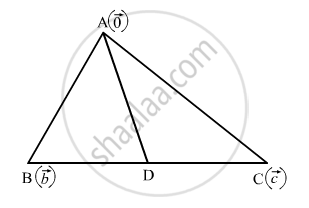
Taking A as the origin, let the position vectors of B and C be \[\vec{b}\] and \[\vec{c}\] respectively.
It is given that AD is the median of ∆ABC.
∴ Position vector of mid-point of BC = \[\vec{AD} = \frac{\vec{b} + \vec{c}}{2}\]................(Mid-point formula)
Now,
\[{AB}^2 + {AC}^2 = \left| \vec{AB} \right|^2 + \left| \vec{AC} \right|^2 = \left| \vec{b} \right|^2 + \left| \vec{c} \right|^2\]
Also,
\[2\left( {AD}^2 + {CD}^2 \right)\]
\[ = 2\left( \left| \vec{AD} \right|^2 + \left| \vec{CD} \right|^2 \right)\]
\[ = 2\left[ \left( \frac{\vec{b} + \vec{c}}{2} \right) . \left( \frac{\vec{b} + \vec{c}}{2} \right) + \left( \frac{\vec{b} + \vec{c}}{2} - \vec{c} \right) . \left( \frac{\vec{b} + \vec{c}}{2} - \vec{c} \right) \right]\]
\[ = 2\left[ \left( \frac{\vec{b} + \vec{c}}{2} \right) . \left( \frac{\vec{b} + \vec{c}}{2} \right) + \left( \frac{\vec{b} - \vec{c}}{2} \right) . \left( \frac{\vec{b} - \vec{c}}{2} \right) \right]\]
\[ = \frac{\left| \vec{b} \right|^2 + 2 \vec{b} . \vec{c} + \left| \vec{c} \right|^2}{2} + \frac{\left| \vec{b} \right|^2 - 2 \vec{b} . \vec{c} + \left| \vec{c} \right|^2}{2}\]
\[ = \frac{2 \left| \vec{b} \right|^2 + 2 \left| \vec{c} \right|^2}{2}\]
\[ = \left| \vec{b} \right|^2 + \left| \vec{c} \right|^2 . . . . . \left( 2 \right)\]
From (1) and (2), we have
\[{AB}^2 + {AC}^2 = 2\left( {AD}^2 + {CD}^2 \right)\]
APPEARS IN
संबंधित प्रश्न
By vector method prove that the medians of a triangle are concurrent.
If the origin is the centroid of the triangle whose vertices are A(2, p, –3), B(q, –2, 5) and C(–5, 1, r), then find the values of p, q, r.
In a triangle OAB,\[\angle\]AOB = 90º. If P and Q are points of trisection of AB, prove that \[{OP}^2 + {OQ}^2 = \frac{5}{9} {AB}^2\]
Prove that: If the diagonals of a quadrilateral bisect each other at right angles, then it is a rhombus.
(Pythagoras's Theorem) Prove by vector method that in a right angled triangle, the square of the hypotenuse is equal to the sum of the squares of the other two sides.
Prove by vector method that the sum of the squares of the diagonals of a parallelogram is equal to the sum of the squares of its sides.
Find the position vector of point R which divides the line joining the points P and Q whose position vectors are `2hati - hatj + 3hatk` and `- 5hati + 2hatj - 5hatk` in the ratio 3:2 is internally.
If the points A(3, 0, p), B(–1, q, 3) and C(–3, 3, 0) are collinear, then find
- the ratio in which the point C divides the line segment AB
- the values of p and q.
The position vector of points A and B are `6bar"a" + 2bar"b"` and `bar"a" - 3bar"b"`. If the point C divides AB in the ratio 3 : 2, show that the position vector of C is `3bar"a" - bar"b"`.
Prove that a quadrilateral is a parallelogram if and only if its diagonals bisect each other.
Prove that the median of a trapezium is parallel to the parallel sides of the trapezium and its length is half of the sum of the lengths of the parallel sides.
In Δ OAB, E is the midpoint of OB and D is the point on AB such that AD : DB = 2 : 1. If OD and AE intersect at P, then determine the ratio OP : PD using vector methods.
If D, E, F are the midpoints of the sides BC, CA, AB of a triangle ABC, prove that `bar"AD" + bar"BE" + bar"CF" = bar0`.
Prove that `(bar"a" xx bar"b").(bar"c" xx bar"d")` =
`|bar"a".bar"c" bar"b".bar"c"|`
`|bar"a".bar"d" bar"b".bar"d"|.`
If `bara, barb` and `barc` are position vectors of the points A, B, C respectively and `5bara - 3barb - 2barc = bar0`, then find the ratio in which the point C divides the line segement BA.
Find the position vector of point R which divides the line joining the points P and Q whose position vectors are `2hat"i" - hat"j" + 3hat"k"` and `-5hat"i" + 2hat"j" - 5hat"k"` in the ratio 3:2
(i) internally
(ii) externally
If A(5, 1, p), B(1, q, p) and C(1, −2, 3) are vertices of triangle and `"G"("r", -4/3, 1/3)` is its centroid then find the values of p, q and r
Prove that medians of a triangle are concurrent
Prove that the angle bisectors of a triangle are concurrent
If G(3, -5, r) is centroid of triangle ABC where A(7, - 8, 1), B(p, q, 5) and C(q + 1, 5p, 0) are vertices of a triangle then values of p, q, rare respectively.
P is the point of intersection of the diagonals of the parallelogram ABCD. If O is any point, then `overline"OA" + overline"OB" + overline"OC" + overline"OD"` = ______
If the position vectors of points A and B are `hati + 8hatj + 4hatk` and `7hati + 2hatj - 8hatk`, then what will be the position vector of the midpoint of AB?
Let `square`PQRS be a quadrilateral. If M and N are midpoints of the sides PQ and RS respectively then `bar"PS" + bar"OR"` = ______.
In ΔABC, P is the midpoint of BC, Q divides CA internally in the ratio 2:1 and R divides AB externally in the ratio 1:2, then ______.
What is the midpoint of the vector joining the point P(2, 3, 4) and Q(4, 1, –2)?
In ΔABC the mid-point of the sides AB, BC and CA are respectively (l, 0, 0), (0, m, 0) and (0, 0, n). Then, `("AB"^2 + "BC"^2 + "CA"^2)/("l"^2 + "m"^2 + "n"^2)` is equal to ______.
M and N are the mid-points of the diagonals AC and BD respectively of quadrilateral ABCD, then AB + AD + CB + CD is equal to ______.
Find the ratio in which the point C divides segment AB, if `5bara + 4barb - 9barc = bar0`
If `bara, barb, barc` are the position vectors of the points A, B, C respectively and `5 bar a - 3 bar b - 2 bar c = bar 0`, then find the ratio in which the point C divides the line segment BA.
The position vector of points A and B are `6bara + 2 barb` and `bara-3 barb`. If the point C divides AB in the ratio 3 : 2 then show that the position vector of C is `3bara -barb`.
The position vector of points A and B are `6bara + 2barb` and `bara - 3barb`. If the point C divides AB in the ratio 3 : 2, then show that the position vector of C is `3bara - barb`.
The position vector of points A and B are `6 bara + 2 barb and bara - 3 barb`. If the point C divides AB in the ratio 3 : 2 then show that the position vector of C is `3 bara - barb`.
The position vectors of points A and B are 6`bara` + 2`barb` and `bara - 3barb`. If the point C divides AB in the ratio 3:2, then show that the position vector of C is 3`bara - b`.
